1 min read
SB 721 California Law: The Total Guide to Balcony Inspection & Repair [2026 Update]
🚨 The SB 721 Deadline Has Passed The January 1, 2026 compliance deadline for SB 721 inspections has come and gone. If your multifamily...
7 min read
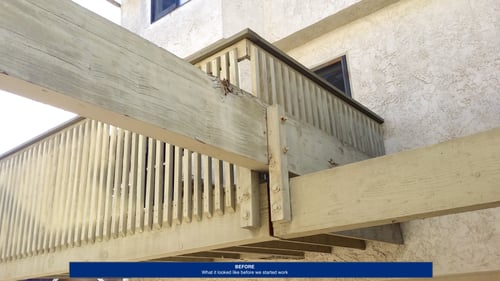
The mandatory initial inspection deadline for most California HOAs under SB 326 was January 1, 2025; however, some jurisdictions and specific building types have until January 1, 2026, to comply due to recent legislative updates.
If you are an HOA board member or property manager in California, you’ve likely heard news about a "deadline extension" for balcony inspections. However, there is a dangerous misunderstanding circulating in boardrooms all over California: The 2026 extension (AB 2579) does NOT apply to most HOAs.
While apartment owners (under SB 721) received a reprieve until January 1, 2026, the deadline for condominium associations under SB 326 (Civil Code §5551) officially passed on January 1, 2025.
If your association has not yet completed its initial inspection of Exterior Elevated Elements (EEEs), you are no longer in a "waiting period", you are in the non-compliance phase!
|
Table of Contents |
|
|
1. The difference between SB 326 and SB 721 balcony laws in 2026 |
|
| 2. Important Facts About SB 326 | |
| 4. How to Spot Balcony Damage Checklist | |
To understand why your HOA might be at risk, you must distinguish between the "Apartment Law" and the "Condo Law."
|
Feature |
SB 326 (Condos/HOAs) |
SB 721 (Apartments) |
|
Primary Deadline |
January 1, 2025 (Expired) |
January 1, 2026 (Extended by AB 2579) |
|
Inspector Requirements |
Architect, Structural, or Civil Engineer |
Architect, Engineer, or GC |
|
Sample Size |
95% Confidence / 5% Margin of Error |
Flat 15% of elements |
|
Reporting |
Included in Reserve Study |
Filed with Local Building Dept |
|
Cycle |
Every 9 Years |
Every 6 Years |
If you are an HOA board member or property manager, you’ve likely heard about a "2026 deadline extension." However, there is a dangerous misunderstanding: AB 2579 did NOT provide a blanket extension for all HOAs.
Per Civil Code §5551, your SB 326 report is not just a safety document; it is a financial one. It must be incorporated into your HOA’s next Reserve Study.
A Reserve Study is a 30-year financial roadmap for your HOA. It’s essentially a "savings plan" to ensure the community can afford to replace expensive items like roofs and elevators without hitting every homeowner with a surprise $20,000 bill.

This is the technical name for the structures we inspect. For a structure to be an "EEE" under California law, it must meet all four of these criteria:
|
Legislative Term |
What it is in Plain English |
The 2026 Impact |
|
SB 326 |
The original "Condo Balcony Law." |
Requires inspections every 9 years for HOAs. |
|
SB 721 |
The "Apartment Balcony Law." |
Requires inspections every 6 years for rental buildings. |
|
AB 2579 |
The 2026 Extension Bill. |
|
|
AB 2114 |
The "Civil Engineer" Lifeline. |
Finally allows Civil Engineers to perform SB 326 inspections, making it easier to find help. |
The law doesn't require us to tear open every single balcony on day one. Instead, it requires a "Statistically Significant Sample."
The SB 721 way (Apartments): A flat 15%. If you have 100 balconies, you check 15. Simple, but less accurate.
The SB 326 way (HOAs): A "95% Confidence Level."
Analogy: Imagine a giant bowl of 100 soup crackers. If you want to be 95% sure that none of the crackers are stale, you can't just taste two or three. You have to taste a large enough "sample" so that the math proves the rest of the bowl is likely safe.
The Reality: For an HOA with 50 balconies, this math often requires inspecting 40 or more balconies, not just 15%.
Lender "Blacklisting": In 2026, banks are rejecting mortgages for condo units if the HOA doesn't have a valid "Balcony Safety Certificate" on file.
The "Special Assessment" Trap: If you don't do the inspection, you can't budget correctly. A surprise balcony failure often results in a massive Special Assessment, forcing every homeowner to pay thousands of dollars on short notice.
If your HOA is behind, there is one piece of good news. AB 2114 was passed as an "urgency statute," effectively immediately.
Previously, SB 326 inspections were restricted to Licensed Architects and Structural Engineers, a very small pool of professionals. AB 2114 expanded this pool to include Licensed Civil Engineers. This is a game-changer for HOAs that have struggled to find available experts. Civil engineers have the technical training to evaluate load-bearing wood-framed structures and waterproofing systems, providing more options and potentially more competitive pricing for associations in 2026.
You don’t need an engineering degree to spot the early warning signs of structural failure. When walking your property, keep an eye out for these five "Silent Killers" of balcony integrity that often lead to failed SB 326 inspections.
What it looks like: Dark water stains on stucco or wood siding, or white, chalky residue (efflorescence) on concrete or brick.
The Red Flag: If you see staining on the underside of a balcony, water has already bypassed the waterproofing and is sitting on the wood framing.
Pro Tip: If you smell a musty, earthy odor near the balconies after a rainstorm, that is the scent of active fungal growth (dry rot).
The Screwdriver Test: If you see wood that looks darkened or "checked" (cracked like alligator skin), try pressing it with a screwdriver.
The Red Flag: Healthy wood should feel like a baseball bat; rotted wood feels like a sponge or cork. If the screwdriver sinks in, you have active rot that requires immediate repair.
What it looks like: "Flashing" is the metal strip connecting the balcony to the building wall. Look for gaps, rust, or metal pulling away from the stucco.
Why it matters: If this seal is broken, water flows directly into the building's structural "skeleton" (the joists), which can lead to a catastrophic collapse.
The Test: Give the railings a firm shake (safely!).
The Red Flag: If the railing post moves at the base, or if the wood around the post is soft, the structural connection is compromised. Railings often fail first because the mounting holes are perfect entry points for water.
What it looks like: The walking surface looks like it’s blistering or peeling.
The Risk: That coating is the only thing protecting the wood subfloor. Once it bubbles, it traps water underneath, creating a "pressure cooker" that accelerates wood decay.
While you see a "little crack in the paint," a licensed professional uses specialized tools to look inside the structure:
Borescope Cameras: We insert tiny cameras into 1/2-inch "exploratory" holes to see if the internal joists are rotting.
Moisture Meters: These detect water levels inside walls that are invisible to the naked eye.
Thermal Imaging: Infrared cameras find "cold spots" that indicate hidden moisture behind your stucco.
Being "late" isn't just about a potential fine from the city; it’s a massive financial liability for the association.
Reserve Study Failures: Per Civil Code §5551, your SB 326 report must be incorporated into your HOA’s next Reserve Study. Without this report, your reserve study is legally incomplete, which can lead to underfunding and massive special assessments down the road.
Insurance Denial: In 2026, insurance carriers are strictly requiring proof of SB 326 compliance before renewing Master Policies. We are seeing HOAs "blacklisted" or facing 300% premium increases because they cannot prove their balconies are structurally sound.
Real Estate Stalls: Sellers in your community may find their escrows failing. Savvy buyers and lenders are now asking for the "SB 326 Certification" as part of the due diligence process. No report = No loan.
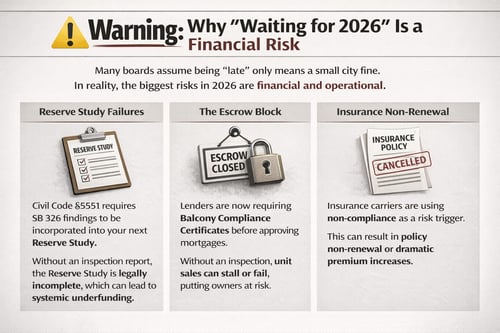
If your association hasn't completed its initial inspection, the "wait and see" approach ended on January 1, 2025. Follow this 4-step checklist to protect your board from liability and secure your association's future.
Confirm if your structures meet the "3-2-6" rule:
3+ Units in the building.
2+ Stories (specifically, elements more than 6 feet above ground).
Wood-based structural supports (load-bearing).
Don't wait months for a structural engineer. Under AB 2114, you can now hire a Licensed Civil Engineer to perform and sign off on your inspection.
Requirement: Ensure they use a "random and statistically significant sample" (95% confidence level).
Tip: Request a "Borescope-first" approach to minimize destructive testing and repair costs.
Once the inspection is finished, the clock starts ticking on three legal obligations:
Board Review: The report must be presented and reviewed at an open board meeting.
Owner Notification: You must provide a written summary of the report's findings to all homeowners within 15 days of the report's completion.
Local Filing: If the inspector identifies an "immediate threat," the report must be delivered to your local code enforcement agency within 15 days.
The final, stamped report must be delivered to your Reserve Study specialist.
The Goal: The study must reflect the "Remaining Useful Life" of your balconies and ensure your HOA is saving enough to cover future repairs.
Record Keeping: The HOA is legally required to keep these reports for at least two inspection cycles (18 years).
SCHEDULE YOUR BALCONY CONSULTATION
![SB 721 California Law: The Total Guide to Balcony Inspection & Repair [2026 Update]](https://www.baycitiesconstruction.com/hubfs/Gallery%20-%20Grassl%20-%20San%20Pedro%20-%20Walkway%20Repair/12%20walkway%20surface%20before%20after.png)
1 min read
🚨 The SB 721 Deadline Has Passed The January 1, 2026 compliance deadline for SB 721 inspections has come and gone. If your multifamily...
1 min read
Why We Created Ultimate AI-Powered Balcony Repair & Waterproofing Chat {% video_player "embed_player" overrideable=False, type='hsvideo2',...
1 min read
In Southern California, balcony waterproofing fails faster than almost anywhere else in the country. The combination of intense UV exposure, coastal...