1 min read
Balcony Repair and Waterproofing: Signs, Costs, and the Mistakes That Make It Worse
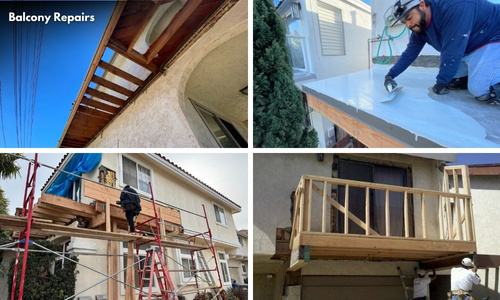
In Southern California, balcony waterproofing fails faster than almost anywhere else in the country. The combination of intense UV exposure, coastal...
21 min read
If you own a home in the South Bay, greater Los Angeles, or Orange County and are planning a kitchen remodel, the first question is almost always "what it will cost"? This guide gives you real 2026 numbers for each of those three markets, breaks down where the money goes, and explains the permit, timeline, and code factors that push Southern California costs above the national average. The goal is for you to walk away knowing what a practical budget looks like for you and how to keep it under control.
|
Quick answer: A kitchen remodel in Southern California typically costs $45,000 to $85,000 for a mid-range project in 2026. A cosmetic refresh runs about $20,000 to $40,000, and a high-end or open-concept renovation with structural work often reaches $100,000 or more. Coastal markets in the South Bay and Orange County sit at the top of these ranges, because buyers there expect premium finishes and some homes carry extra permit requirements. Most kitchens in the region land around $250 to $450 per square foot. |
The national average kitchen remodel runs about $27,000, and most projects across the country land between $15,000 and $75,000. Southern California sits well above that! Regional labor and materials generally run 20 to 30 percent higher than national averages, and in coastal markets the gap widens to 40 to 60 percent. A mid-range kitchen that costs $50,000 in much of the country commonly runs $70,000 to $90,000 here.
Because it changes how you think about every number in this guide, one point worth making before you continue reading the ranges below, is the price of a kitchen remodel tracks the scope of work far more than the address it sits at. A remodel with the same cabinets, the same counters, and the same layout changes costs close to the same whether the home is in Torrance or Newport Beach. Coastal neighborhoods report higher averages for two reasons: homeowners there tend to choose larger projects and higher-end finishes, and some coastal homes face extra permit steps. The contractor charges the same for identical work regardless of the zip code. That means you control most of your final number through the decisions you make about scope and materials.
|
Key takeaway: You control most of your final cost. Scope and material choices move the number far more than your city does. The same kitchen, specified the same way, prices similarly in Torrance or Newport Beach. |
| Remodel Level | Typical SoCal Cost (2026) | What's Included |
| Cosmetic refresh | $20,000 - $40,000 | Surface updates, same layout, nothing moved |
| Mid-range remodel | $45,000 - $85,000 | New cabinets, counters, appliances, minor layout changes |
| Upscale/open-concept | $100,000+ | Structural changes, premium finishes, full redesign |
Southern California is not one market. The South Bay, greater Los Angeles, and Orange County each have their own housing stock, permit processes, and buyer expectations, and those differences are noticeable in the final cost. Here is how the three break down in 2026.
| Market | Typical Mid-Range (2026) | What Shapes the Price |
| South Bay | $50,000 - $95,000 | Older homes, coastal finish expectations near the beach |
| Greater Los Angeles | $45,000 - $90,000 | Widest housing stock, LADBS permitting, design-driven buyers |
| Orange County | $50,000 - $100,000+ | Coastal premium vs. master-planned HOA standards |
The South Bay sits inside Los Angeles County, but its kitchen costs behave differently from the county as a whole. The coastal cities, Manhattan Beach, Hermosa Beach, and Redondo Beach, along with the four cities of the Palos Verdes Peninsula, Palos Verdes Estates, Rancho Palos Verdes, Rolling Hills, and Rolling Hills Estates, carry the same premium-finish expectations you find in any high-value beach market, so mid-to-high-range projects there commonly run $70,000 to $120,000 or more. Inland communities like Lomita, Gardena, and Carson tend to be more moderate, often $45,000 to $75,000 for a mid-range remodel, because finish expectations are different. Torrance spans both worlds, with coastal-adjacent neighborhoods near the water and larger inland areas, so costs there track the specific neighborhood and the scope more than a single citywide figure.
One factor that catches South Bay homeowners off guard is that each city is its own municipality with its own building department, permit process, fees, and review timelines. A kitchen remodel in Manhattan Beach moves through a different process than the same project in Torrance or Rancho Palos Verdes, and the coastal cities can carry additional review. Knowing the local process for your specific city is part of keeping a project on schedule, and it is one of the things we handle for you.
A large share of South Bay housing was built between the 1940s and the 1970s, so opening walls frequently reveals older wiring and plumbing that has to be brought up to current code. That is one of the most common reasons a South Bay budget needs a healthy contingency.
South Bay at a glance:
Greater Los Angeles covers an enormous range of housing, from 1920s bungalows to hillside contemporaries, so the cost range is the widest in the region. A mid-range remodel generally runs $45,000 to $90,000, and upscale or structural projects climb past $150,000. Two factors shape an LA kitchen budget more than anywhere else in Southern California. The first is permitting through the Los Angeles Department of Building and Safety, where plan check for structural or layout work commonly takes two to four weeks and fees run among the highest in the state. The second is the age and condition of the housing stock, because many homes carry decades of prior work that was never permitted and has to be corrected once a new permit is pulled.
Greater Los Angeles is also a patchwork of jurisdictions, and which one your home falls under changes the permit process. Many areas that people think of as part of LA are actually independent cities with their own building departments, including West Hollywood, Beverly Hills, Culver City, Santa Monica, and Long Beach. Others, like San Pedro and Brentwood, are neighborhoods within the City of Los Angeles and permit through LADBS. The same remodel can move through a very different process depending on which side of that line your address sits, so confirming the right jurisdiction is one of the first things we do.
Greater Los Angeles at a glance:
Orange County is its own market, and it splits into two distinct submarkets. Along the coast, in Newport Beach, Laguna Beach, Corona del Mar, and Dana Point, kitchens carry a 15 to 25 percent premium over inland projects. Salt air calls for corrosion-resistant hardware, moisture-tolerant cabinetry, and marine-grade fixtures, and homes inside the Coastal Commission overlay zone need an extra permit layer that can add four to eight weeks to the schedule. Mid-to-high-range coastal kitchens there commonly run $75,000 to $175,000, and ultra-premium projects with Wolf or Sub-Zero packages reach well beyond that. Inland, in master-planned communities like Irvine, Costa Mesa, Mission Viejo, and Lake Forest, the picture shifts. Costs are more moderate, often $50,000 to $100,000 for a quality remodel, but homeowners association design rules frequently govern what you can change, and buyers there expect an updated kitchen as a baseline. Across the county, the typical mid-range project lands around $78,000.
As in the rest of the region, each Orange County city is its own jurisdiction. Newport Beach, Huntington Beach, Irvine, Costa Mesa, and the others each run their own building department with its own permit process, fees, and review timelines, and the coastal cities layer the Coastal Commission overlay on top. A remodel in Huntington Beach does not move through the same process as the same project in Irvine, so knowing the local requirements for your specific city is part of keeping the budget and schedule accurate.
Orange County at a glance:
If you are comparing quotes across these markets, hold the scope constant. The same kitchen, specified the same way, should price within a similar range across the region. Wide swings between bids usually mean the scopes are not actually the same, which is the single most important thing to check before you sign anything.
Most kitchen remodels fall into one of three levels, and the right one depends on your goals, your timeline, and how long you plan to stay in the home. Bay Cities Construction builds to all three and organizes every project around this good, better, best model, so you can see exactly what each level includes and what moves a project from one level to the next.
A cosmetic refresh updates the look of the kitchen while keeping the footprint and layout in place. It is the right choice when the layout already works and you want a current, fresh result without moving plumbing or walls.
The moment you move the sink, relocate the range, or take down a wall, the project leaves this level, because that work brings plumbing, electrical, and sometimes structural trades into the job.
A full remodel replaces the kitchen completely and can adjust the layout within the existing walls. This is the most common level for homeowners who want a better-functioning new kitchen but are not opening the space to the rest of the house.
An open-concept transformation reconfigures the space structurally, often opening the kitchen to living areas and, in many South Bay and coastal homes, to ocean views. It is the most involved level, and it brings in structural engineering, a full permit set, and the most finish-intensive work, which is why it carries the highest cost.
The good, better, best model is not a standard industry practice. It is the Bay Cities approach, built so you can match the project to your goals and budget with a clear picture of the scope at each level.
Size and layout are two of the largest cost drivers, but they work together in a way that surprises a lot of homeowners. The number that matters most is not square footage. It is the linear feet of cabinetry and countertop the kitchen carries, because cabinets and counters are the biggest line items in the budget. A compact U-shaped kitchen can carry more cabinet run, and cost more, than a larger but sparse galley.
| Key takeaway: Linear feet of cabinetry and countertop drive cost more than square footage. A compact U-shaped kitchen can cost more to remodel than a larger galley. |
| Kitchen Size | Approx. Square Footage | Typical SoCal Range (mid-range) |
| Small (10x10) | 100 sq ft | $25,000 - $45,000 |
| Medium | 150 - 200 sq ft | $45,000 - $80,000 |
| Large | 200+ sq ft | $80,000 - $150,000+ |
The 10x10 kitchen is a common benchmark because it is close to the size of many standard kitchens, which is why cost guides quote it so often. Use it as a reference point, not as a quote for your specific space.
Many older Southern California kitchens are small and walled off from the rest of the house. Expanding them is appealing, but it usually means removing a wall, which moves the project into structural and permit territory and changes the budget accordingly. That is worth knowing before you assume a small kitchen will be a small project.
In the Los Angeles area, a quality kitchen remodel that meets current design and building standards generally runs $250 to $450 per square foot in 2026, and premium work runs higher. National figures that quote $100 to $250 per square foot do not reflect this market and will set your expectations too low.
Per-square-foot pricing is also a weak way to estimate a kitchen in particular. The kitchen packs more cost into each square foot than any other room in the house, because plumbing, gas, electrical, cabinetry, counters, and appliances are all concentrated in one space. A bedroom remodel spreads its cost across a large, mostly empty floor. A kitchen does not. That concentration is why small kitchens often cost more per square foot than large ones, since the expensive systems cost about the same regardless of floor area. Treat the per-square-foot figure as a rough planning range, and rely on a detailed scope for your real number.
| Why kitchens cost more per square foot: plumbing, gas, electrical, cabinetry, counters, and appliances are all packed into one room. A bedroom spreads its cost over mostly empty floor. A kitchen does not, which is why small kitchens often cost more per square foot than large ones. |
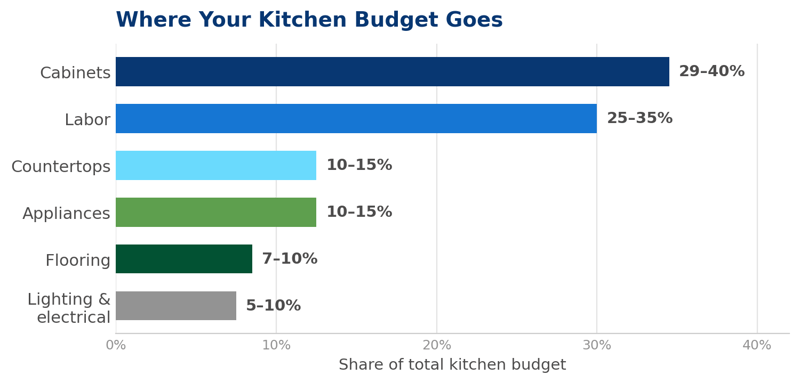
Knowing how a kitchen budget breaks down tells you where to invest and where you can pull back. Across most projects, the spending lands in roughly these proportions.
| Component | Share of Budget | Notes |
| Cabinets | 29% - 40% | The single largest line item |
| Labor | 25% - 35% | Higher in coastal California markets |
| Countertops | 10% - 15% | Quartz and natural stone at the top |
| Appliances | 10% - 15% | Professional-grade raises this sharply |
| Flooring | 7% - 10% | Tile, hardwood, or luxury vinyl |
| Lighting & electrical | 5% - 10% | Recessed, under-cabinet, fixtures, controls |
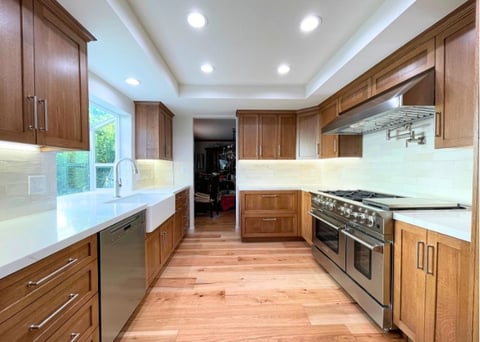
Cabinets drive more of the budget than anything else, and the grade you choose has a significant affect on the
number.
Pre-fab cabinets run roughly $5,000 to $12,000 for a typical kitchen and work well for standard layouts.
Semi-custom runs about $12,000 to $25,000 and adds sizing and finish flexibility, which is why it is where most Southern California homeowners land.
Custom cabinetry starts around $25,000 and climbs past $50,000, and it earns its cost in kitchens with non-standard dimensions, specific storage needs, or a design that off-the-shelf sizes cannot meet.
Countertop cost depends on material.
Laminate runs about $10 to $25 per square foot installed.
Quartz, the most popular choice in the region, runs about $50 to $90 per square foot and holds up well with little maintenance.
Natural stone like quartzite or marble sits at the top, both in price and in upkeep.
Appliances look like a simple line item until you choose professional-grade equipment. A commercial-style range rarely costs more on its own alone. It often pulls in a chain of upgrades that catch homeowners off guard:
This is why two kitchens with identical cabinets can differ by $15,000 once the appliance package changes. A useful rule is to invest in the surfaces you use and see every day, cabinets and counters, and to economize on the elements that are easy to change later, like hardware, paint, and decorative fixtures.
No two kitchens are the same size, have the same layout, or the same material selections, which is why costs vary so widely.
Here are six factors drive what your project will actually cost 👇
The premium our region carries is not arbitrary. It comes from specific local cost drivers that homeowners in other parts of the country do not face to the same degree.
A cosmetic refresh can be finished in a few weeks. A full remodel with new cabinetry and layout changes runs longer once design, permitting, and material lead times stack up, and a structural or open-concept project runs longer still. In the Los Angeles area, a typical remodel spans roughly six to sixteen weeks from permit through completion, and coastal projects inside the Coastal Commission overlay can add four to eight weeks on top of that.
The part that surprises most homeowners is that construction is rarely the long pole. The schedule is usually set by two things that happen before any demolition starts. The first is permit plan check, which commonly takes two to four weeks at LADBS. The second is custom material lead time, since custom cabinets can take many weeks to build and deliver. Finalizing selections and ordering cabinets early is the single most effective way to keep a kitchen on schedule.
| The schedule is set before demolition: permit plan check (2 to 4 weeks) and custom cabinet lead time (often the longest single item) usually matter more than construction itself. Lock your selections and order cabinets early. |
| Phase | Typical Duration | What Happens |
| Design and selections | 2-4 weeks | Layout, materials, and appliances finalized |
| Permitting / plan check | 2 - 4 weeks (longer on the coast) | City review, Title 24 documentation approvals |
| Material lead time | 4 - 12 weeks | Custom cabinets are often the long pole; overlaps other phases |
| Construction | 4 - 10 weeks | Demolition, rough trades, install inspections, finish |
At Bay Cities, you do not get a vague timeline. After your design is approved and the job scope is signed, you receive a projected completion date and a full schedule in your online client portal, and your project manager keeps it current through the final walk-through.
Most kitchen remodels in Southern California require a building permit. A purely cosmetic update that keeps everything in place sometimes does not require one, though it is always worth confirming with your city's building department. A permit is almost always triggered the moment the project does any of the following:
When the lighting changes, the permit set also has to include Title 24 documentation, which is reviewed during plan check and verified at inspection.
Permitting is not uniform across the region. The Los Angeles Department of Building and Safety handles a high volume, and plan check can take two to four weeks, while Orange County cities and coastal jurisdictions run their own processes, some faster and some slower. Older homes carry an added wrinkle, because past work that was never permitted can surface during review and has to be resolved before the new project moves forward. Bay Cities prepares and submits the permit set, coordinates Title 24 compliance, and walks every inspection through to final approval, so you are not standing at a city counter on your own.
The biggest budget risk in a kitchen remodel is not the price on the proposal. It is the change order that follows. Some contractors win the job with a low number built on allowances, which are placeholder dollar amounts for items you have not selected yet. A proposal might carry a $5,000 cabinet allowance, but once you choose the cabinets you actually want, the real number comes in at $15,000 or $18,000, and the difference arrives as a change order after you have already committed. Stack a few of those across cabinets, counters, tile, and appliances, and the final cost lands far above the figure you signed.
Bay Cities quotes differently. We develop the full design and material selections first, then price the project on the actual quantities of materials and the actual labor hours the work requires. The number you sign is the number you pay, unless you change the scope during construction or we uncover a hidden condition behind the walls. There are no allowances padding the bottom line and no built-in path to surprise change orders.
| Allowance-based quote (typical lowball) | Scope-based quote (Bay Cities) |
| Placeholder dollar amounts for items you haven't chosen yet | Priced on the actual materials and labor hours the work requires |
| The real cost lands later, as change orders | The number you sign is the number you pay * |
| Final total often well above the signed price | No allowance padding and no built-in surprises |
*Unless you change the scope during construction or we uncover a hidden condition behind the walls.
One honest point applies to every remodel, and especially to older Southern California homes. No one can see behind the walls until demolition begins, so it is wise to set aside a contingency of 15 to 20 percent for hidden conditions like outdated wiring, failing plumbing, or unpermitted past work. We tell you that at the start rather than discovering it together halfway through.
Plan for it: set aside a 15 to 20 percent contingency for hidden conditions, especially in older Southern California homes where wiring, plumbing, or unpermitted past work can surface during demolition. |
A kitchen remodel is one of the highest-return projects a Southern California homeowner can take on, and it consistently ranks at or near the top of any single-room improvement at resale. Mid-range projects tend to recoup 60 to 80 percent of their cost, and they usually return a higher percentage than high-end projects, because buyers expect an updated kitchen but do not always pay a premium for top-tier finishes.
How that return shows up depends on the market. In high-value coastal neighborhoods like Newport Beach, Manhattan Beach, and the Palos Verdes Peninsula, the dollars are larger but the percentage is often lower. A $100,000 kitchen in a $2.5 million home might add $65,000 to $75,000 in value, and in those markets a dated kitchen can work against the sale, because premium finishes are what buyers already expect. In master-planned inland communities like Irvine, a well-judged $50,000 remodel can return 70 to 80 percent and make a home stand out in a neighborhood full of identical floor plans. The smart play in either market is to modernize the kitchen to the level of the neighborhood without over-improving past it.
| Market Type | Example Project | Typical Return |
| Coastal high-value (Newport, Manhattan Beach, PV, etc...) | $100k kitchen in a $2.5M home | $65K to $75k added; a dated kitchen can hurt the sale |
| Inland master-planned (Irvine, Mission Viejo, etc...) | $50k kitchen in a $900k home | 70 - 80 percent recouped; stands out vs identical floor plans |
| Regional rule of thumb | Mid-range remodel | 60 - 80 percent recouped, higher than high-end projects |
|
📝
Ready to Start Your Kitchen?Get an accurate, scope-based estimate built around your space, your selections, and your budget. No allowances, no surprise change orders. Request a Quote📷
See Our Work FirstBrowse completed kitchen, balcony, and remodeling projects across the South Bay, Los Angeles, and Orange County before you reach out. View the Gallery |
1 min read
In Southern California, balcony waterproofing fails faster than almost anywhere else in the country. The combination of intense UV exposure, coastal...
1 min read
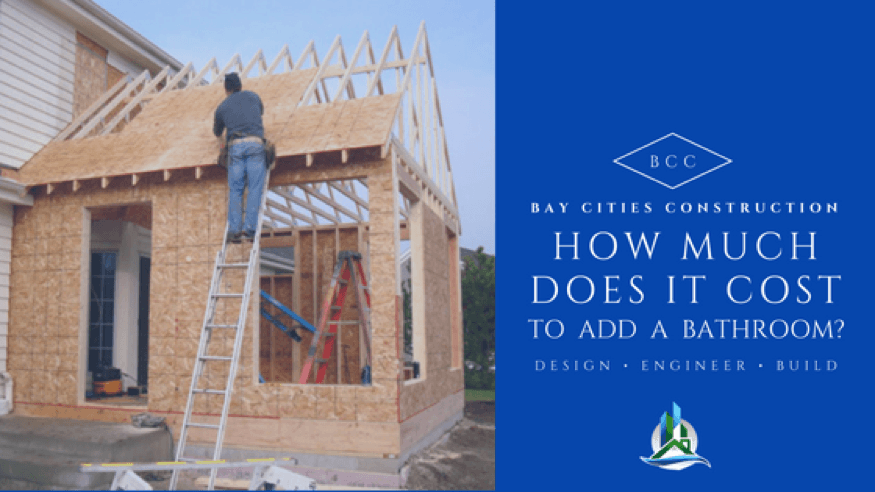
If you have a large family with a single bathroom, you’ll know the pain of having to share a bathroom with other people. Sometimes adding a new...
1 min read
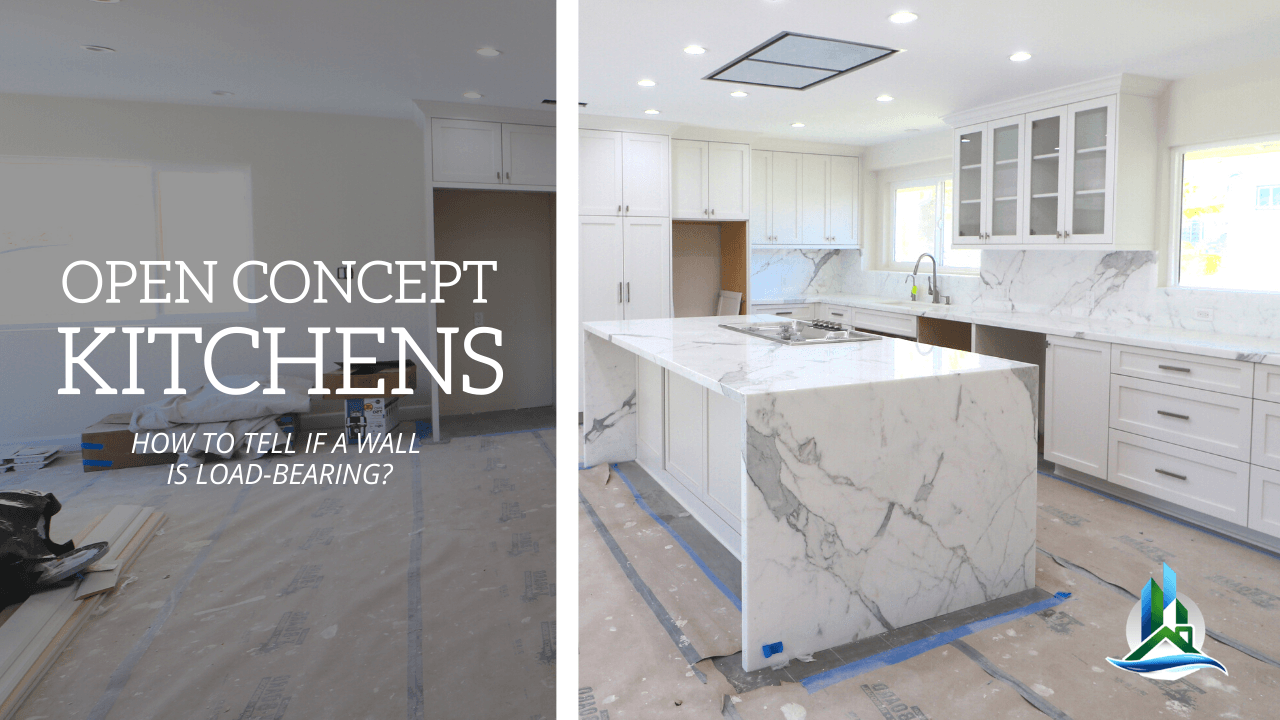
One of the most popular kitchen remodeling projects in the South Bay over the last several years has been opening up the kitchen by removing...