1 min read
Black Vinyl Windows and Doors: Pros, Cons, and Cost
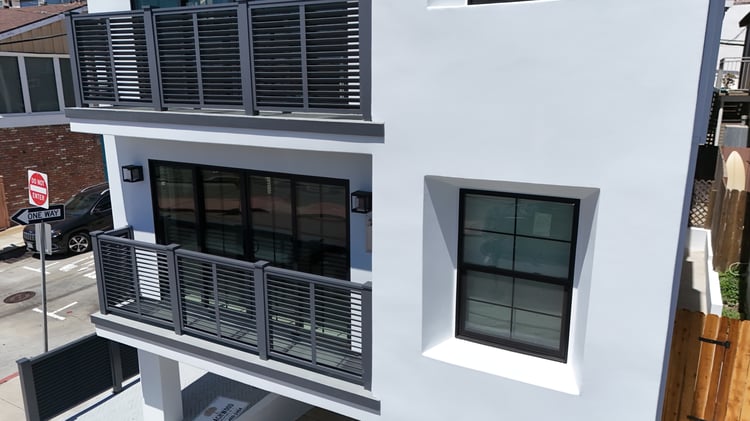
Black vinyl windows and doors have become one of the most requested upgrades for homes in Southern California. The dark frame gives a clean, modern...
10 min read
Vinyl windows cost about $450 to $1,200 per window installed for standard sizes, and replacing every window in a typical 15 to 17 window home runs roughly from $8,000 to $26,000 depending on the window style and the installation method. Simple retrofit replacements sit at the lower end of that range, and full-frame replacements that involve cutting back stucco or siding cost more. Vinyl is the most affordable framing material for replacement windows, and because labor in the South Bay, Los Angeles, and Orange County runs higher than the national average, local installed pricing tends to land in the middle to upper part of the published national ranges.
This guide breaks down what vinyl windows cost by style, how much of the price is the window versus the labor, the difference between a retrofit and a full-frame replacement, and the local factors that move the number up or down for homeowners across Southern California.
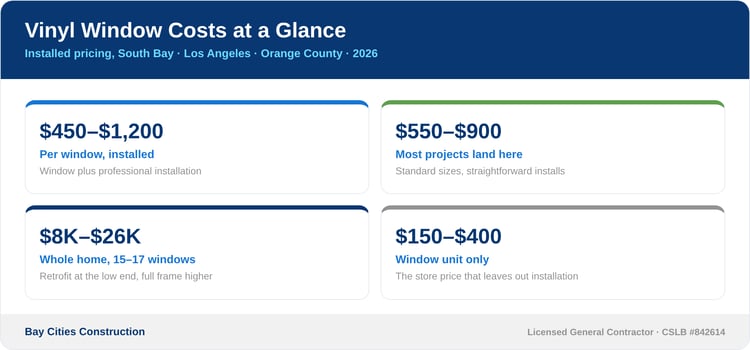
Most homeowners across our service area pay between $450 and $1,200 per window installed for standard vinyl replacement windows, with the majority of straightforward projects landing between $550 and $900 per window. Larger windows, premium brands, and full-frame replacements push the number higher, and a basic retrofit of a standard size window can come in lower.
Window pricing does not change dramatically from one Southern California county to the next, but a few local conditions do affect what you pay. Coastal homes in the South Bay and along the Orange County coast deal with salt air and constant UV exposure, which makes the quality of the window and the installation more important and can nudge pricing toward better product lines. Older homes with original aluminum windows and stucco exteriors often need more preparation than a newer home with sound framing. The table below shows typical installed ranges for standard vinyl windows across the three markets we serve.
|
Market |
Standard vinyl window, installed |
Notes |
|---|---|---|
|
South Bay |
$500 to $1,200 per window |
Coastal exposure in beach cities raises the value of a quality install |
|
Los Angeles |
$450 to $1,150 per window |
Wide housing stock, from 1920s bungalows to newer builds |
|
Orange County |
$500 to $1,200 per window |
Coastal and inland pricing both fall in this range |
These ranges reflect current Southern California pricing for professionally installed standard size windows. The sections below explain what moves a project to the lower or upper end.
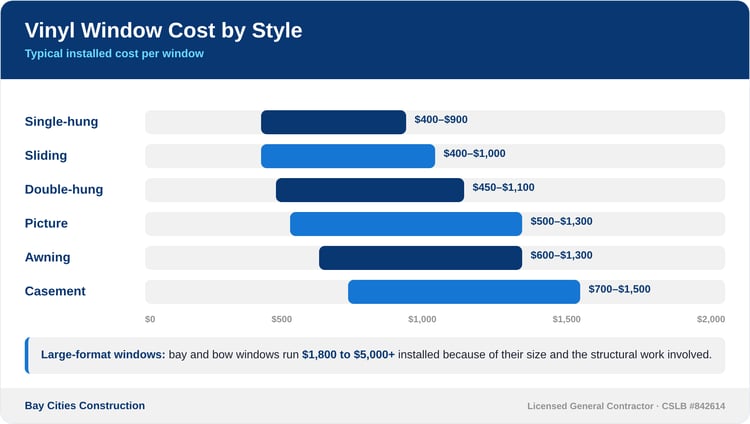
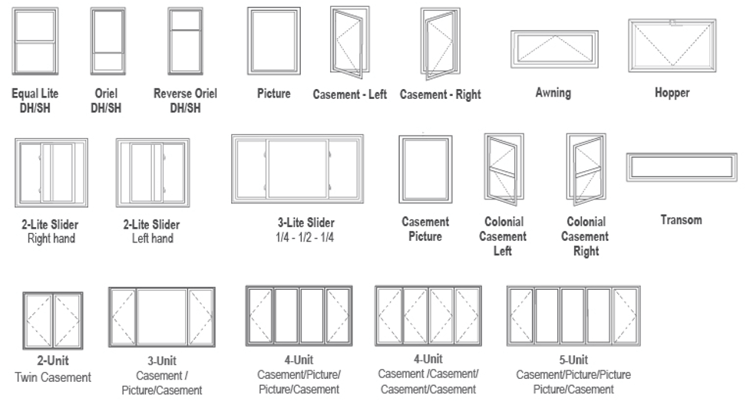
Window style is one of the biggest drivers of cost because each operation type uses different hardware and takes a different amount of labor to install. Single-hung and sliding windows are the most affordable because they have the simplest mechanics. Casement windows cost more because they use a crank operator and a compression seal. Bay and bow windows sit at the top of the range because of their size and the structural work involved. The table below shows typical installed pricing for vinyl windows by style.
|
Window style |
Installed cost per window |
How it operates |
|---|---|---|
|
Single-hung |
$400 to $900 |
Bottom sash slides up, top sash is fixed |
|
Sliding or gliding |
$400 to $1,000 |
Sash slides horizontally |
|
Double-hung |
$450 to $1,100 |
Both sashes slide and tilt in for cleaning |
|
Awning |
$600 to $1,300 |
Hinged at the top, swings outward |
|
Picture |
$500 to $1,300 |
Fixed, does not open, large glass area |
|
Casement |
$700 to $1,500 |
Hinged at the side, opens with a crank |
|
Bay or bow |
$1,800 to $5,000+ |
Multiple windows set in a projecting frame |
Most homes use a mix of styles, so your total project cost reflects the combination you choose rather than a single per-window figure. If you are trying to keep costs down, single-hung and sliding windows give you the lowest price per opening while still meeting current energy requirements.

The installed price of a vinyl window combines two parts, the window unit itself and the labor to install it. The window unit for a standard size runs roughly $150 to $400 for most residential models, and higher for larger sizes or premium brands. Professional installation adds roughly $225 to $350 per window, and removing and disposing of the old window usually adds another $100 to $185 per opening.
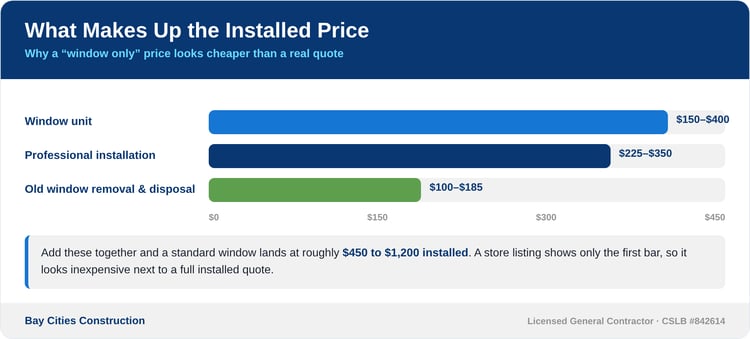
This is why the per-window prices you see on home improvement store websites are misleading for a real project. A store listing shows the unit price only, which looks inexpensive next to an installed quote. The installed number is the one that matters, because it accounts for the labor, the removal of the old window, the sealing and waterproofing, and the finish work that makes the window perform the way it should. A window installed poorly will cost you more over time in energy bills and water intrusion than you saved on the unit price.
Retrofit windows, also called replacement or insert windows, fit into the existing window frame without removing the stucco, siding, or interior trim. Full-frame replacement, often called new construction installation, removes the old window down to the studs, which means cutting back the stucco or siding, installing a new window with a nailing flange, and patching and painting both the interior and exterior afterward. Full-frame installation runs about 50 to 65 percent more than a comparable retrofit because of the added labor.
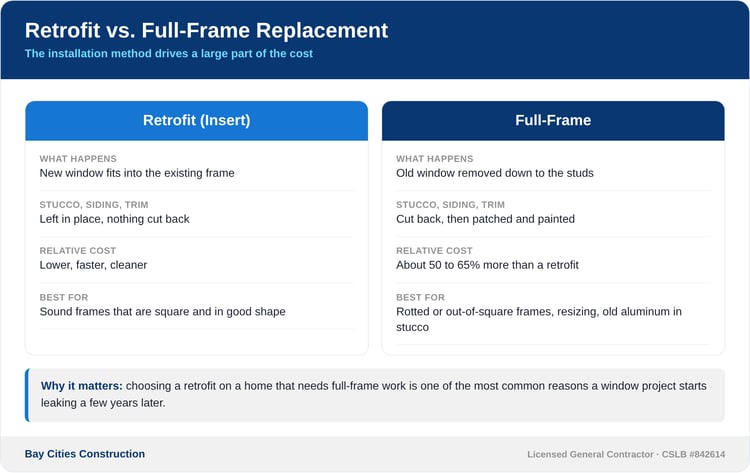
Retrofit is the right method for most homes with sound framing and existing openings that are square and in good condition. It is faster, cleaner, and less expensive, and it works well with the Z-bar retrofit frames commonly used on stucco homes throughout Southern California.
Full-frame replacement is the better method in a few specific situations:
The existing frames are rotted or out of square, where a retrofit will not seal correctly.
You are changing the size or shape of the opening, which means the wall has to be opened up.
You are replacing old aluminum windows in a stucco home, where a full-frame approach lets the installer rebuild the waterproofing connection behind the stucco and prevent the leaks that come from failed or missing waterproofing paper.
Choosing the cheaper retrofit method on a home that needs full-frame work is one of the most common ways a window project ends up leaking a few years later.
Several factors move a vinyl window project up or down in price. Understanding them helps you read a quote and know where your money is going.


Glass package- Dual-pane glass with a Low-E coating and argon gas fill is the standard for Southern California and is required to meet current energy code. Upgrades such as triple-pane glass or laminated glass for sound control add to the price and are worth considering for homes near freeways, flight paths, or busy streets.
Number of windows- Replacing several windows at once lowers the per-window price because the crew mobilizes once and works efficiently across the whole job.
Home access and height- Second-story windows and windows with difficult access take more time and equipment, which raises labor.
California Title 24, the state energy code, sets minimum energy performance standards that every replacement window has to meet, and the current 2025 standards took effect on January 1, 2026. For the coastal and basin climate zones that cover most of the South Bay, Los Angeles, and Orange County, replacement windows must meet a maximum U-factor of 0.30 and a maximum solar heat gain coefficient of 0.23. The exact climate zone is tied to your property address and is confirmed when the permit is pulled.
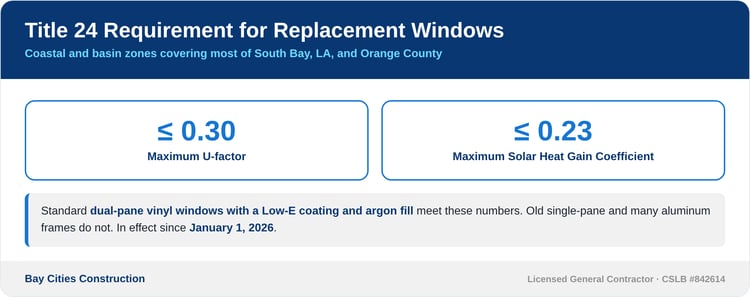 In practice, standard dual-pane vinyl windows with a Low-E coating and argon fill meet these numbers, which is one reason vinyl is the default choice for replacement projects in our area. Old single-pane windows and many original aluminum frames do not comply, because aluminum conducts heat and struggles to hit the required U-factor. Title 24 compliance is built into the cost of any properly installed replacement window today, so it is a requirement rather than an optional upgrade. When you compare quotes, confirm that the windows are rated to meet Title 24 for your climate zone so the project passes inspection.
Window replacement generally requires a building permit in Los Angeles, the South Bay cities, and Orange County, and the permit and inspection confirm that the new windows meet Title 24 and egress requirements. A simple like-for-like retrofit that keeps the same size and operation usually needs only a single inspection, which keeps the permitting straightforward. Changing the size of an opening, converting a window to an egress size for a bedroom, or doing full-frame work involves more review and more inspections.
Permit fees vary by city and are a small part of the overall project, but the inspection matters because it verifies the work was done to code. As a licensed general contractor, Bay Cities Construction handles the permitting and coordinates the inspections as part of the project, so the compliance side is managed for you rather than left as homeowner paperwork.
A typical single-family home in Southern California has 15 to 17 windows, and replacing all of them is where most homeowners want a real number. For a standard retrofit replacement with quality dual-pane vinyl windows, a whole-home project generally runs from about $8,000 to $19,000 depending on the window styles, sizes, and brand tier. A full-frame replacement that involves cutting and patching stucco runs higher, generally from about $15,000 to $26,000 or more for the same home.
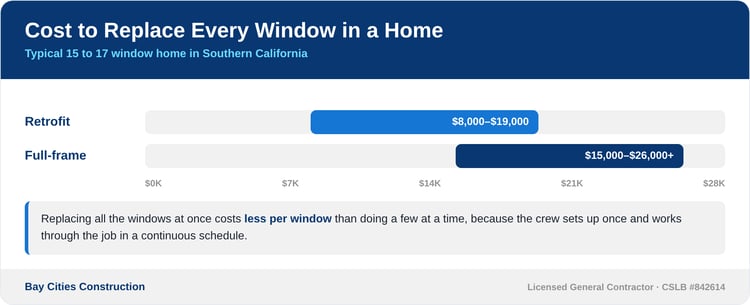 Replacing every window at once almost always costs less per window than doing them a few at a time, because the crew sets up once and completes the work in a continuous schedule. If your budget does not allow the whole house at once, a common approach is to start with the windows in the worst condition or the ones facing the most sun and weather exposure, then phase the rest.
Vinyl window brands fall into roughly three tiers, and the tier you choose affects both the price and how the window holds up over time. Economy and builder-grade windows, including many store brands, carry the lowest price and work for short-term needs or rental properties. Mid-tier lines offer a strong balance of price and durability and are the most common choice for Southern California homes. Premium lines use the heaviest frames, the best glass packages, and the longest warranties.
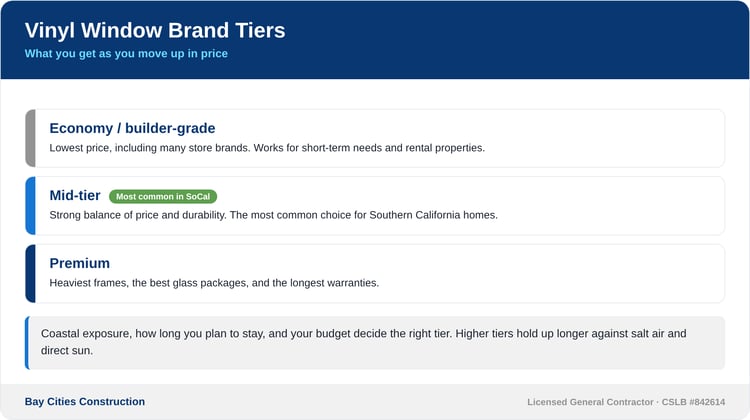 Brands commonly installed in Southern California span these tiers, from mid-tier manufacturers through premium lines. The right brand for your home depends on how long you plan to stay, your exposure to coastal conditions, and your budget.
The federal tax credit that previously covered energy-efficient windows is no longer available. The Section 25C Energy Efficient Home Improvement Credit, which offered up to $600 toward qualifying windows, expired on December 31, 2025 under the One Big Beautiful Bill Act. Windows installed in 2026 and later do not qualify for that federal credit, though homeowners who installed qualifying windows in 2025 can still claim it on their 2025 tax return.
California does not currently offer a broad standalone rebate that pays a set amount per vinyl window. Energy-efficient window upgrades can contribute to whole-home energy rebate programs and may qualify for occasional local utility incentives, and the programs change from year to year. The most reliable way to check current options is through your electric and gas utility and the DSIRE database of state incentives. For most homeowners today, the real financial return on new vinyl windows comes from meeting Title 24, lowering energy bills through better insulation, and avoiding the repair costs that come with failing single-pane or aluminum windows.
The ranges in this guide tell you what to expect, but the only way to know what your project costs is an estimate based on your actual windows, their sizes, the condition of the existing frames, and the installation method your home needs. An online average cannot see whether your frames are square, whether your stucco needs full-frame work, or which climate zone sets your Title 24 requirement.
Thorough upfront scoping is what prevents the change orders that come from quoting on visible conditions alone. When a contractor measures every opening, checks the condition of the framing and waterproofing, and confirms the right installation method before the work starts, the price you agree to is the price you pay. Bay Cities Construction has installed hundreds of windows across the South Bay, Los Angeles, and Orange County over more than 20 years as a licensed general contractor, and we handle the full project including the window selection, permitting, installation, and finish work.
To get a quote built around your home, Request an Estimate and our team will walk you through the options that fit your windows and your budget.

1 min read
Black vinyl windows and doors have become one of the most requested upgrades for homes in Southern California. The dark frame gives a clean, modern...

1 min read
The popularity of vinyl windows exploded in the 1990's, they offered good looks at bargain prices. But that 'bargain' pricing produced low quality...
