1 min read
What's a Soft-Story? | What You Should Know About Soft-Story Retrofits
Retrofits are Now Mandatory in Los Angeles? Soft story retrofitting in Los Angeles and Santa Monica are no longer something that is...
14 min read
The City of Torrance adopted Ordinance No. 3916 on March 14, 2023, and it took effect on April 11, 2023. The ordinance requires seismic evaluation and structural retrofit of older buildings that the City has identified as vulnerable to severe damage or collapse during a major earthquake. For most residential property owners in Torrance, the relevant portion is Article 1, which covers existing wood-frame buildings with soft, weak, or open-front walls.
If you own an older apartment building in Torrance with parking or open commercial space underneath the units, Torrance’s soft story ordinance likely applies to you. As of the date this article was last verified, the City has not mailed notification letters to affected properties, and the compliance deadlines in the ordinance do not begin until an owner receives an official Order from the City. No covered building in Torrance is currently behind schedule, and the full five-year compliance window is still ahead of every owner in the program.
Bay Cities Construction is a licensed general contractor headquartered in Torrance, and we handle seismic and foundation work throughout the South Bay, Orange County, and Los Angeles.
What you’ll learn in this article:
| • what the ordinance requires | • which buildings it covers |
| • what the timeline looks like once the letters go out |
• what owners can do in the meantime |

Ordinance No. 3916 was approved unanimously by the Torrance City Council on March 14, 2023 and became effective on April 11, 2023. It establishes a mandatory seismic retrofit program for older buildings constructed under design standards that have since been replaced. The City has stated that Torrance contains hundreds of buildings with potential seismic deficiencies, and that without a mandate to retrofit them there is a high possibility they could be severely damaged during a major seismic event, with the potential for loss of life.
The ordinance addresses four categories of building that the City has identified as carrying the highest risk of significant damage during a large earthquake:
Wood buildings with soft, weak, or open-front walls
Buildings containing non-ductile concrete, which were typically designed under pre-1980s codes and contain brittle concrete elements with too little steel reinforcement to hold the concrete intact during shaking
Buildings with pre-Northridge steel moment frames
Buildings with rigid-wall-flexible-diaphragm wall anchorage system deficiencies
Article 1 of the ordinance covers the first category, and that is the portion most residential property owners in Torrance will deal with.
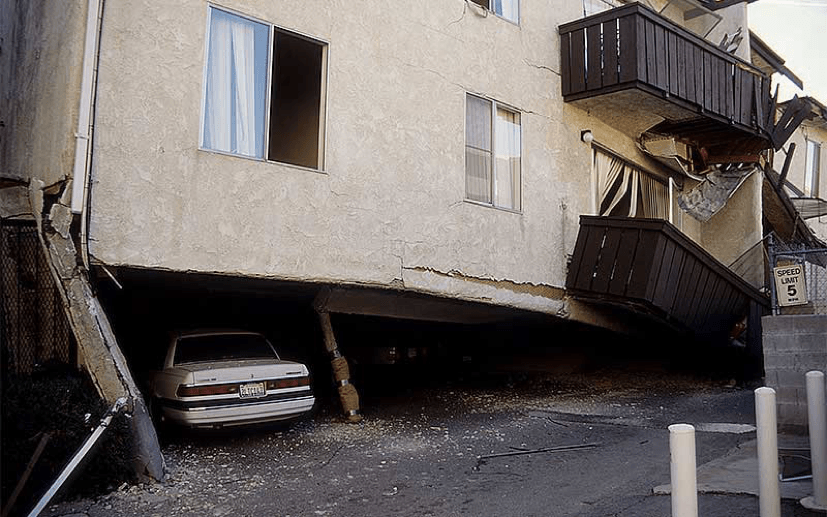
The City defines a wood-framed building with soft, weak, or open-front walls as a multi-story wood structure where the first story is substantially weaker and more flexible than the stories above it; usually because the first floor lacks walls or frames. These buildings were commonly designed before the 1980s and contain large open areas used for tuck-under parking or ground-floor commercial space such as restaurants and convenience stores. During an earthquake, lateral movement concentrates at that weak first story, and without proper strengthening the soft story floor may suffer structural damage or complete failure.
 A braced ground floor holds its shape during an earthquake. A soft story racks sideways at the open floor, where the damage concentrates.
The soft story provisions apply when the Building Official determines that a building meets the following conditions:
The building was constructed under building code standards enacted before the 1976 Uniform Building Code, with local amendments adopted on August 1, 1978.
The ground floor or basement portion of the structure contains parking or other similar open floor space that causes soft, weak, or open-front wall lines, or the majority of the ground floor or basement contains open floor space.
There are one or more stories above that open ground floor.
The structure is a residential building containing four or more dwelling units.
All of these conditions have to be present. A duplex or triplex with tuck-under parking sits below the unit threshold, and a commercial building with an open storefront is not a residential building. Both fall outside Article 1.
In practical terms, the buildings most likely to fall within the ordinance are two- and three-story wood-frame apartment buildings built between the early 1950s and the late 1970s, with cars parked underneath the living units. Torrance has a substantial inventory of this construction type, particularly in the older neighborhoods around Old Torrance and along the corridors where multifamily development was concentrated during that period.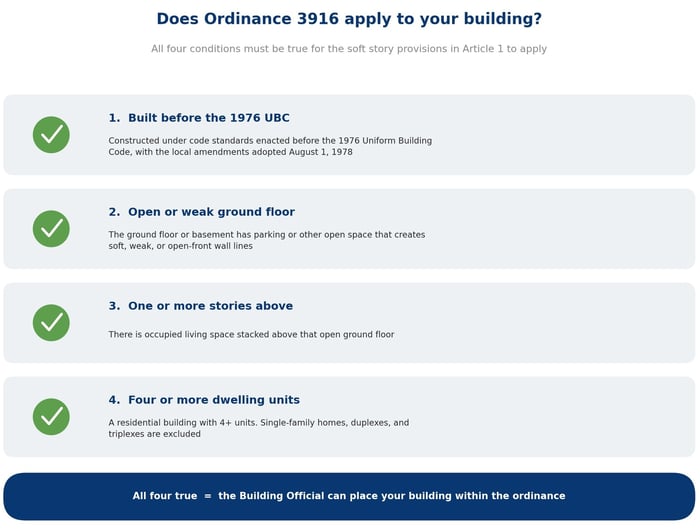
Age by itself does not place a building in scope. A pre-1978 apartment building with a fully enclosed ground floor and continuous perimeter walls does not have the open-front condition the ordinance targets. The determination belongs to the Building Official, and it is made building by building.
| Quick check: is your building likely in scope? | |
| • Older than the 1976 UBC (roughly pre-1978 construction in Torrance) | |
| • Parking or open space on the ground floor, with living units above | |
| • Four or more dwelling units | |
| • If all three describe your building, plan as though an Order is coming |
No. As of the last verification date on this article, the City of Torrance states on its Seismic Retrofit Program page that it is in the process of preparing for the implementation stage and that notification letters have not yet been sent to the affected properties.
This matters more than any other detail in the ordinance. The compliance deadlines do not run from the date the ordinance passed. They begin when the owner is served with an official Order from the Building Official. Three years after adoption, no Torrance building owner is late, and no compliance date has passed.
But just because you haven’t received a letter does not mean you’re exempt! The ordinance took effect in April 2023, so it’s enforceable, and Orders will be issued by priority level once the City activates the program.
Owners who want to confirm the status of a specific property can contact the Torrance Community Development Department at 3031 Torrance Blvd, by phone at (310) 618-2550, or by email at seismic@torranceca.gov
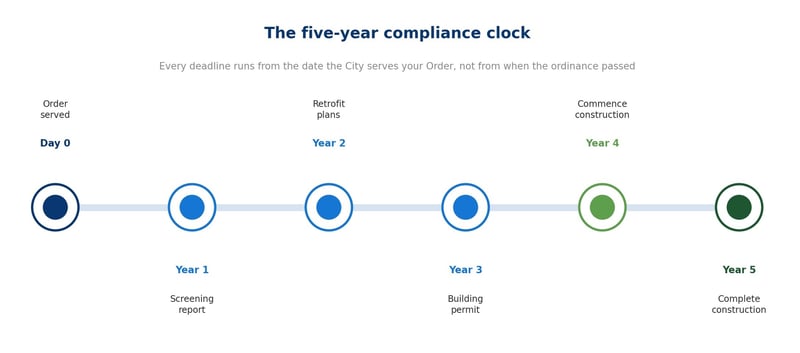
Once an Order is served, the deadlines below apply, and each one is measured from the date of that notice.
| Compliance milestone | Deadline from date of Order |
| Submit screening report prepared by a California licensed design professional | 1 year |
| Submit retrofit plans | 2 years |
| Obtain building permit | 3 years |
| Commence construction | 4 years |
| Complete construction and obtain final approval | 5 years |
Five years reads as a generous window on paper. Structural engineering, plan check corrections, permit issuance, tenant notification, parking relocation, and the construction itself all consume real calendar time, and owners who wait until year three to begin the engineering often find that the permit and construction milestones arrive faster than they planned for. The screening report deadline in year one sets the pace for everything that follows it.
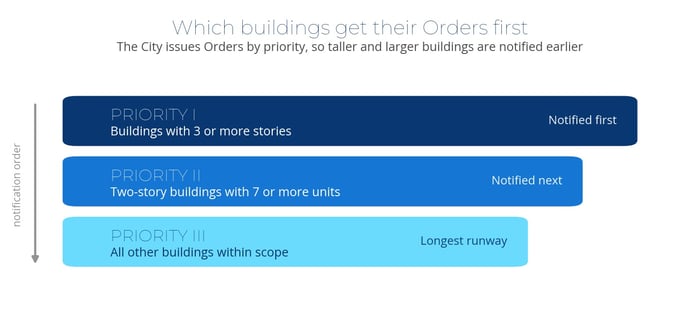
The ordinance establishes three priority groups that determine the order in which the City issues order notices to owners of buildings expected to fall within its scope.
| Priority level | Buildings included |
| Priority I | Buildings containing three or more stories |
| Priority II | Two-story buildings containing seven or more units |
| Priority III | Buildings that do not fall within Priority I or Priority II |
For example: a three-story building will receive its order before a two-story fourplex on the same street. Owners of Priority III buildings have the longest runway, though the length of that runway will not be clear until the City publishes its notification schedule.
 What is a screening report, and who can prepare one?
The ordinance requires that buildings within its scope be investigated and analyzed by a California licensed design professional. That analysis produces the screening report, which establishes whether the building meets the minimum seismic standards set out in the ordinance. If it does, the owner documents the finding with the City. If it doesn’t, the owner must complete the required strengthening work within the compliance timeline.
The ordinance requires the investigation and analysis to be performed by a licensed design professional, and it requires the professional to sign a statement on the approved plans taking responsibility for the seismic design.
🏆 Bay Cities works closely with a structural engineering partner who prepares and stamps those plans, and Bay Cities manages the project turn-key from there, coordinating the engineering, the permitting, the construction, and the inspections as one process.
The purpose of the retrofit is to add strength and stiffness at the ground floor opening so the building resists lateral forces without concentrating movement to its weakest story. The specific methods depend on what the engineer specifies, but most projects use some combination of the following: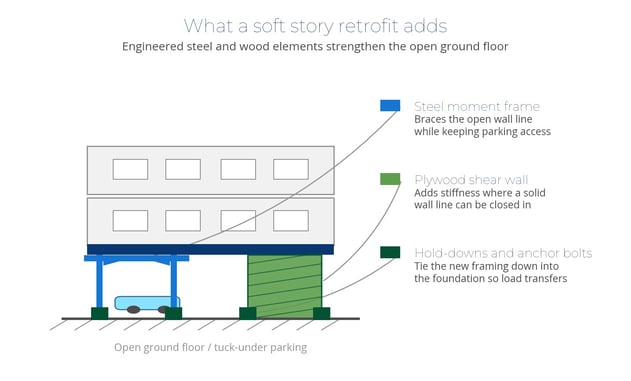
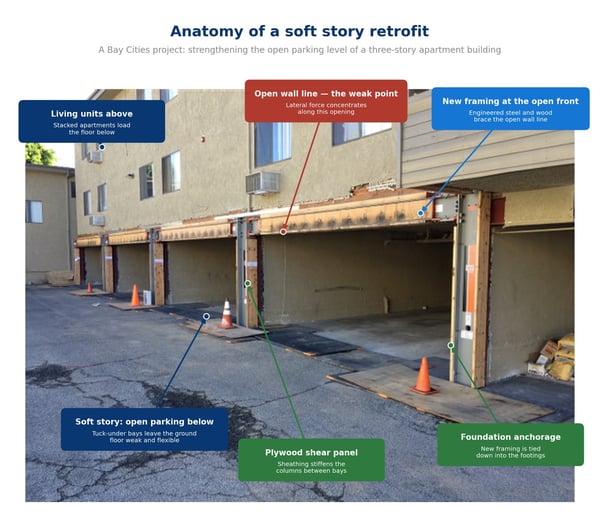
Steel moment frames installed across the open wall line, typically at the garage or carport opening, where a solid shear wall would eliminate vehicle access.
Plywood shear walls added to existing wall lines, often by replacing stucco or drywall with structural sheathing.
Hold-downs and anchor bolts that tie the framing to the foundation so the strengthened walls transfer load into the ground rather than sliding or lifting.
Foundation work where existing footings cannot carry the loads that new frames or shear walls introduce.
Keep in mind that the framing itself isn’t what dictates the construction schedule of soft story projects. Parking loss during construction, utility and gas line relocations, garage door and access modifications, and coordination with occupied units account for more of the calendar than the structural work does.
| What dictates the construction timeline | |
| • Loss of parking access during construction | |
| • Utility and gas line relocations | |
| • Garage door and ground-floor access changes | |
| • Coordinating the work around occupied units |
Costs on a soft story retrofit are of course based on the building, and severity of damage. These are the variables that decide the cost of the retrofit:
The number and width of open bays that require steel frames
Whether the existing footings can carry the new loads or need to be enlarged or replaced
The condition of the existing framing and foundation, which is not fully known until the walls and slab are opened
Access constraints, including whether crews and equipment can reach the garage area
The number of occupied units and the amount of tenant coordination required
Whether plan check returns structural revisions that change the retrofit approach
The screening report is the point at which the scope becomes specific. Until a licensed engineer has evaluated the building and specified the retrofit approach, any figure is just an estimate built on assumptions about the conditions behind the walls and below the slab. Careful upfront evaluation reduces the number of surprises during construction, but keep in mind just like with any construction, there are some conditions that only become visible once demolition begins and can change the scope- be sure to keep a contingency fund of 10-15% specifically for any unforeseen variables.
Bay Cities Construction prices soft story retrofit work by assessment, based on the extent of the deficiency and the size of the building, and delivers the project turn-key. That means one team coordinates the engineering partner who produces the plans, the permitting through the Torrance Building and Safety Division, the construction, and the inspections, so the owner is not managing an engineer, a contractor, and a permit expediter as three separate relationships.
Free Consultation · Torrance, CA
Think Your Building Needs a Retrofit?
Tell us about your building and we'll walk through whether it falls under Ordinance 3916, what a retrofit would involve, and what the next step should be. If an on-site visit makes sense, we'll schedule that to assess the damage in detail and prepare your quote.
SCHEDULE A FREE CONSULTATION →A building found to be within the scope of the ordinance that is not brought into compliance within the timeframe may be declared unsafe and made subject to Section 116 of the California Building Code, which governs unsafe structures.
The ordinance also carries a penalty provision:
A violation is a misdemeanor unless the City reduces it to an infraction, and each day the violation continues is treated as a separate offense.
On conviction, the penalty can reach a fine of up to $1,000 per day, up to six months in jail, or both, and those penalties are in addition to any other costs the City is entitled to recover.
In practice the City works through orders, appeals, and extensions long before penalties enter the picture, but the enforcement authority is real and it’s written into the code.
There is one more consequence worth understanding. If a building misses its deadlines, the Building Official can record a certificate with the Los Angeles County Recorder stating that the building is within the scope of the ordinance and requires retrofit. That recording attaches to the property record, where a buyer, a lender, or a title company will find it. Once the building is retrofitted and in compliance, the Building Official records a certificate clearing it.
|
How non-compliance escalates |
|
| • The building can be declared unsafe under CBC Section 116 | |
| • A violation is a misdemeanor, with each day a separate offense | |
| • Penalties can reach $1,000 per day, up to six months, or both | |
| • The City can record a certificate against the property that a buyer or lender will find |
Yes to both, and the two work differently.
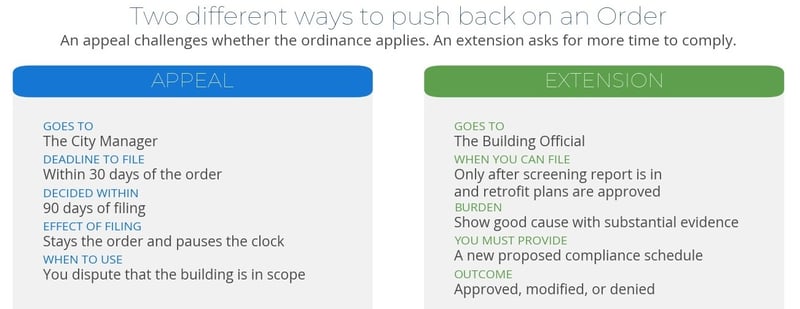
An owner who believes the Building Official has wrongly placed the building within the scope of the ordinance, or wrongly concluded it must be retrofitted, can appeal to the City Manager. The appeal has to be filed within 30 days of the Building Official's order or decision, and the City Manager decides it within ninety days of filing. Filing the appeal stays the underlying order and its time limits while the appeal is pending, so the compliance clock pauses. If the appeal is denied, the original time limits are restored unless the City Manager sets new ones.
An extension works differently, and the timing rule surprises owners. An extension request cannot be filed at the start. Under the ordinance it may only be filed after the owner has already submitted the screening report and had the retrofit plans approved by the City. An owner has to be through the first two milestones before asking for more time on the ones that follow. The owner carries the burden of showing good cause with substantial evidence, such as documented difficulty securing funding or a contractor despite best efforts, and has to submit a new proposed compliance schedule. The Building Official can then approve it, approve it with modifications, or deny it.
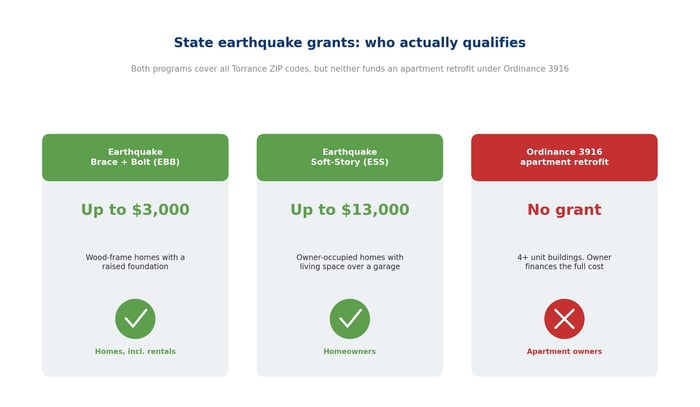
No, in almost every case. Two state programs administered through the California Residential Mitigation Program now cover all Torrance ZIP codes, and neither one funds the retrofit of an apartment building under Ordinance 3916.
Earthquake Brace + Bolt (EBB) provides up to $3,000 for eligible wood-frame homes with raised foundations, with supplemental funding available for income-qualified households. As of 2025 the program also accepts non-owner-occupied homes, including rentals, though it remains a brace-and-bolt grant for raised-foundation houses rather than a soft story program. Earthquake Soft-Story (ESS) provides up to $13,000 for owner-occupied homes with living space built over a garage, and the home must have been built before 2000 to qualify.
Both programs fund single-family and small residential structures, not the four-plus unit buildings the ordinance covers. If you own an apartment building that falls within Ordinance 3916, plan on financing the retrofit yourself. If you own a house in Torrance with living space above the garage, the ESS program is worth applying for whether or not the ordinance touches your property.
Not the seismic portion of the work, provided you file for the exclusion. California Revenue and Taxation Code section 74.5 states that new construction does not include the portion of an existing structure consisting of the construction or reconstruction of seismic retrofitting components, but that portion is excluded from reassessment.
Several contractor websites summarize this as a flat statement that a retrofit will not increase your assessed value. The statute is narrower than that, and the details matter to the building owner:
Owners of buildings in Torrance file with the Los Angeles County Assessor, using the claim form the State Board of Equalization prescribes. The filing deadline is the part owners miss most often, because it’s based off the completion date rather than the tax year.
Owners who hold buildings in both cities will find the two ordinances similar in structure and different in the details that affect planning.
| Torrance (Ord. 3916) | Los Angeles (Ord. 183893) | |
| Adopted | March 14, 2023 | 2015 |
| Effective | April 11, 2023 | 2015 |
| Buildings identified | Hundreds, final count not published | Approximately 13,500 wood-frame soft story |
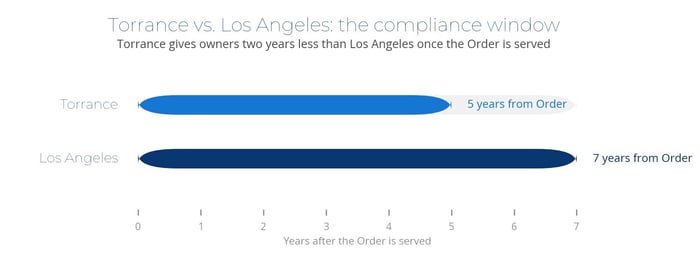
| Compliance window | 5 years from Order | 7 years from Order |
| Clock starts | Service of the Order | Service of the Order |
| Orders issued | Not yet as of last verification | Issued beginning 2016 |
| Local rent stabilization | None. AB 1482 applies statewide | RSO applies to pre-Oct 1978 rentals |
| Retrofit cost recovery | No local pass-through program | Up to 50% of cost, surcharge capped at $38/month for 120 months, LAHD approval required |
The cost recovery line item is the main difference. An owner of a rent-stabilized building in Los Angeles can apply to the Los Angeles Housing Department to recover half the retrofit cost from tenants through a temporary monthly surcharge, capped at $38 per unit and running up to 120 months. Torrance has no local rent stabilization ordinance and no equivalent cost recovery program, so rent increases are governed by the statewide Tenant Protection Act.
A Torrance owner should plan on carrying the full cost of the retrofit. Owners with questions about what rent increases their specific tenancies allow should speak with an attorney, since Bay Cities Construction does not give legal advice.
The city of Torrance gives owners a window two years shorter than the one Los Angeles gave. Los Angeles also had years of program administration, published building inventories, and an established plan check pathway before most owners began work. Torrance owners will enter a program that is still being stood up, which in other cities has meant slower plan check during the early cycles and a smaller pool of contractors with local ordinance experience.
The notification letters have not been mailed, which gives Torrance owners a window that owners in Los Angeles and Santa Monica never had. The work that can be done ahead of the Order is the work that shortens the timeline once it arrives.
Bay Cities Construction has been a licensed general contractor for more than twenty years, serving Los Angeles, the South Bay, and Orange County. If you own a building that may fall within Ordinance 3916, we can walk the property, assess the ground-floor condition and the foundation, and coordinate the engineering and permitting that compliance requires.
| Before the notice arrives, you can | |
| • Pull the permit history and confirm the construction year | |
| • Photograph the ground-floor and parking condition | |
| • Get a preliminary structural opinion ahead of the screening report | |
| • Plan for parking loss during construction | |
| • Understand the foundation the new frames will load |
If Ordinance 3916 applies to your building, you have time to plan the work before the City sends your notice. Knowing what your building needs now puts you ahead of the deadlines.
|
📝
Talk to us about your buildingEvery soft story retrofit is priced on the building, damage, and the size of the job. Tell us about your property and we will scope the work and give you an estimate built around it. Request a Quote📷
See our work firstSee our completed retrofit, foundation, and remodeling work across the South Bay, Los Angeles, and Orange County before you reach out. View the Gallery |
.jpg)
1 min read
Retrofits are Now Mandatory in Los Angeles? Soft story retrofitting in Los Angeles and Santa Monica are no longer something that is...
1 min read
Do you know all the retrofit solutions that are available for your soft-story building? The most common solution is to install special moment frames...
1 min read
If you look around a typical Los Angeles neighborhood, there’s no doubt you will find a soft story building. Soft Story buildings are easy to...