1 min read
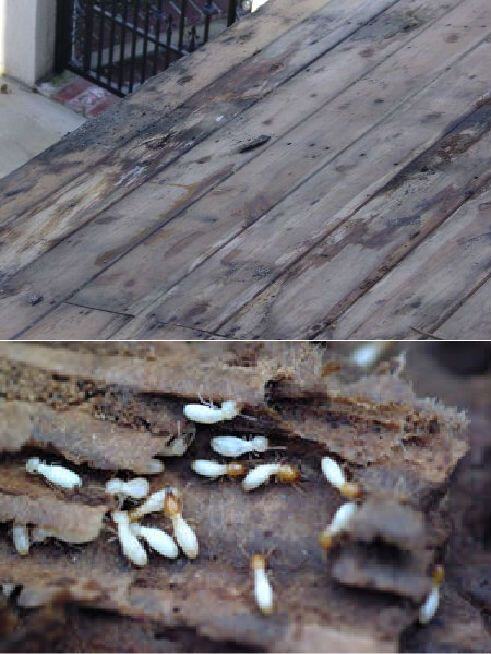
How to Prevent Termite Damage on a Wood Deck
Wood decks are the most susceptible to elements. As a result wood decks will suffer from dry rot and UV damage. Here are a few tips on how to prevent...
4 min read
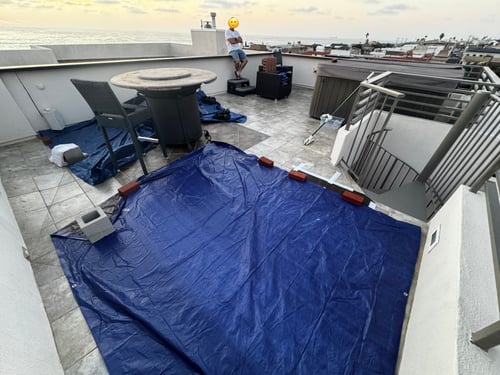
When a tile balcony or rooftop deck begins to leak, most homeowners assume it’s due to a cracked tile or a grout issue. In reality, tile itself is rarely the root problem. Tile is not waterproof, its simply a layer that sheds water. The true protection is the membrane beneath the tile, and once that membrane stops working, water begins to migrate into the framing below.
Understanding how tile assemblies behave outdoors is the key to diagnosing leaks correctly and preventing long-term structural damage.
Tile is attractive and durable indoors, but outdoor conditions are far more demanding. Rain, heat, movement, and temperature changes constantly stress the surface. Because tile and grout are porous materials, they allow moisture to pass through naturally. That moisture isn’t a problem on its own, but it becomes a problem when the waterproofing layer beneath the tile stops doing its job.
Most leaks don’t originate at the tile surface like most people think, they begin when water repeatedly works its way through the grout and tile assembly and the underlying membrane fails to move that water toward the drain.
Outdoor tile systems behave differently than interior tile installations. Grout absorbs water, thinset retains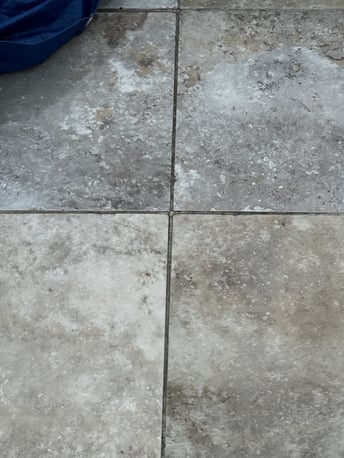 moisture, and the balcony structure expands and contracts with daily temperature swings. These conditions create tiny pathways that allow water to move beneath the tile.
Once water enters the mortar bed, capillary action helps it spread horizontally across the balcony. This is usually when homeowners start noticing early symptoms such as whitening on the grout (efflorescence), soft spots, or tiles beginning to sound hollow. These are indicators that moisture has already been sitting under the surface for some time.
If you see white, chalky residue (efflorescence), that is a major warning sign:
It means water has been sitting under your tile for weeks or months.
Beneath every tile balcony is a thinset or screed layer, and beneath that layer is the waterproofing membrane. When the waterproofing system is built correctly, water that penetrates the grout eventually reaches the membrane, follows the slope, and drains away through weep holes built into the drain assembly.
But leaking balconies share a few underlying problems: the membrane is flat, improperly sloped, or installed with low spots that hold water. Instead of draining, moisture becomes trapped between the tile surface and the membrane. Over time, this constant saturation weakens the adhesive, causes tiles to lift or sound hollow, and allows water to sit in areas never designed to hold moisture.
This trapped water has only one place to go once the membrane gives out and that's straight into the framing!
Once water gets through the grout, it hits the layer below the tile which is either thinset or a mortar bed. That layer stays saturated until it can reach a drain or evaporate.
The membrane is flat or sloped incorrectly
Water pools in low spots
Moisture sits between the tile and membrane
Thinset breaks down
Tiles go hollow or start popping
This is usually when homeowners first realize something is wrong.
A leak becomes visible when trapped water finally finds a weak point in the system. This is usually not a single crack but a failure in how the membrane transitions into surrounding structures.
The most common entry points include:
The base of walls where the membrane does not turn up high enough
Sliding door thresholds that weren’t sealed correctly
Drain assemblies where the membrane was not fully wrapped into the drain
Perimeter transitions that were grouted instead of properly flashed
Once water reaches the plywood or framing, the damage accelerates rapidly, especially on cantilever balconies, where structural members extend outside the building and are more vulnerable to rot.
By the time water shows up in the ceiling or on the interior wall, the damage behind the finishes is often significant.
Tile can be installed outdoors successfully but only if the correct waterproofing system is used underneath. Two systems are commonly used in Southern California, depending on whether the balcony has a plywood or concrete subfloor.
Here are the two accepted waterproofing assemblies:
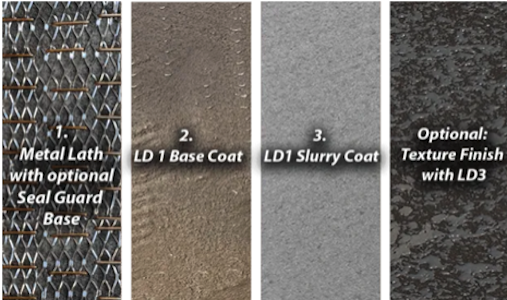
Life Deck AL-UT System (For Plywood Balconies)This system adds structure, reinforcement, and waterproof protection to wood-framed balconies. What It Includes
This system isolates tile movement from wood movement and dramatically reduces cracking and leaking.
|
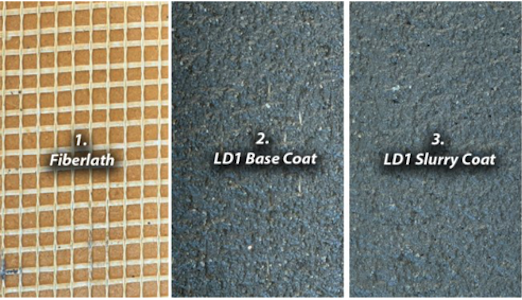
Life Deck MC-UT System (For Concrete Balconies)Concrete expands, contracts, and cracks, so this assembly uses flexible reinforcement. What It Includes
This prevents small concrete cracks from transferring into your tile or grout.
|
|
Important: Do NOT Use a Top Coat Under Tile Life Deck’s walking-surface systems use a top coat. Tile needs the rough texture of the slurry coat for proper adhesion. |
|
Across thousands of inspections and repairs, we consistently see the same underlying issues:
Tile installed directly over plywood with no waterproofing
Membranes that were never tied into the drain
Flat decks with no slope
Membranes that stop too low where the floor meets the wall
Thinset not rated for exterior temperature swings
Cracks caused by expansion and contraction
Missing reinforcement between wood framing and tile
Once the waterproofing layer fails, cosmetic fixes such as re-grouting or adding sealant will not solve the problem. The only long-term solution is to rebuild the waterproofing system beneath the tile.

Tile can be used outdoors, but it requires a properly engineered waterproofing system beneath it, not just adhesive and grout. When leaks begin, the damage behind the tile is usually more advanced than what you can see on the surface. Early signs like efflorescence, loose tiles, or moisture inside the home should never be ignored.
You likely need a full balcony rebuild, not a cosmetic repair. If you’re seeing:
leaks into the unit below
efflorescence on grout
loose or hollow tiles
moisture inside walls
rotted framing or fascia
SCHEDULE YOUR BALCONY CONSULTATION

1 min read
Wood decks are the most susceptible to elements. As a result wood decks will suffer from dry rot and UV damage. Here are a few tips on how to prevent...
1 min read
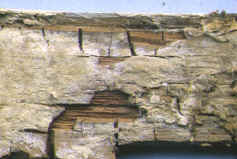
Here’s a news flash! For those of you that may not be aware, the South Bay has a ton of dry rot damage. Perhaps it is because of the damp evenings...

1 min read
Attention home owners, do you have a wood deck or wood fencing? Wood decks are susceptible to the elements and they require occasional...