1 min read
Balcony Repair and Waterproofing: Signs, Costs, and the Mistakes That Make It Worse
In Southern California, balcony waterproofing fails faster than almost anywhere else in the country. The combination of intense UV exposure, coastal...
15 min read
A patch or repair is the right choice when three things are true. The damage is on the surface or in one area, the source of the water can be found and stopped, and the framing, connections and rebar are still sound.
Replacement is the right choice when the framing or connections have rotted or corroded, when past repairs keep failing, or when the balcony no longer meets building code.
In every case, keep people off a balcony that cracks, sags or moves, and have a qualified professional inspect it before you decide.
Deciding whether to repair or replace a balcony comes down to what's happening underneath the surface and what each choice costs over the years while you own the property. A patch job looks cheaper on paper and sounds appealing but it often comes back as a larger repair. Why? Because the water or structural problem that caused the first failure keeps causing damage even after the surface is sealed.
This matters for homeowners with a balcony on their own building, and it matters for the HOA boards and property managers who oversee balconies across multi-unit buildings in Los Angeles, the South Bay and Orange County. The combination of coastal salt air, strong UV exposure and seasonal rain wears down balcony waterproofing faster here than in other parts, so the question of repair versus replacement comes up often and deserves a clear answer.
Patching, repairing and replacing describe three different levels of work. Many sources use the words interchangeably, which is confusing and makes the decision harder than it needs to be.
Patching is surface and cosmetic work, such as sealing a crack, re-coating a worn surface or fixing one small spot without opening the structure underneath.
A structural repair is targeted work that opens a defined area, replaces compromised framing or waterproofing, and restores the load the balcony is built to carry.
A replacement, sometimes called reconstruction, rebuilds the balcony from the structure out and resets the service life of both the framing and the waterproofing.

Knowing which of the three a balcony needs is the first step, because a patch applied where a structural repair is required definitely won't hold. California law uses the term "exterior elevated element" aka EEE for balconies, decks, porches, stairways, walkways and entry structures that extend beyond the exterior walls, have a walking surface more than six feet above ground, and rely in whole or in substantial part on wood or wood-based products for support. Inspection reports for apartments and condominiums use that term so they're easily recognizable.
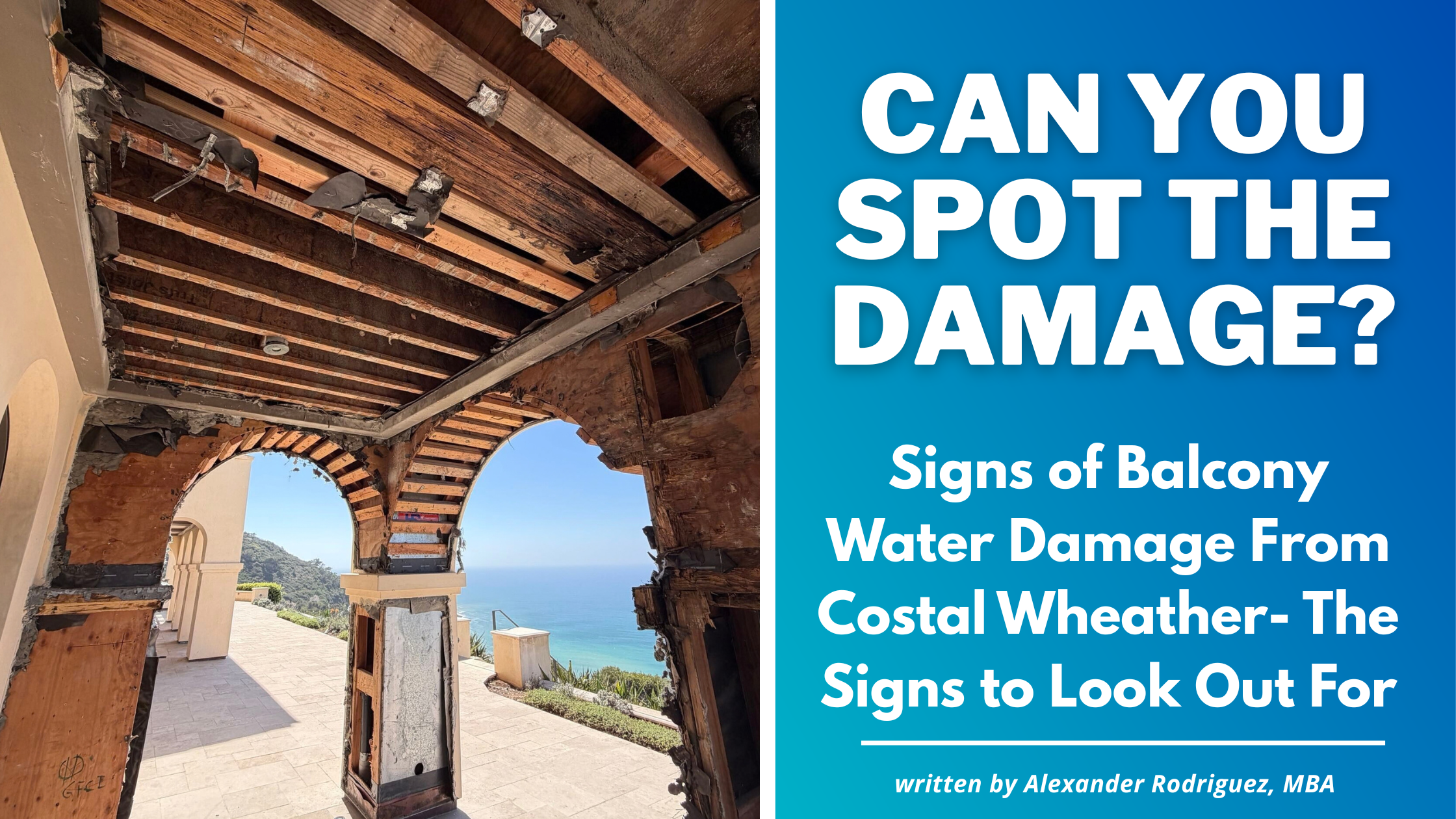
Some signs point to a problem that has reached the structure, and these call for an assessment before any surface work is planned. The signs below are commonly cited by inspectors and contractors as reasons to look beneath the surface.
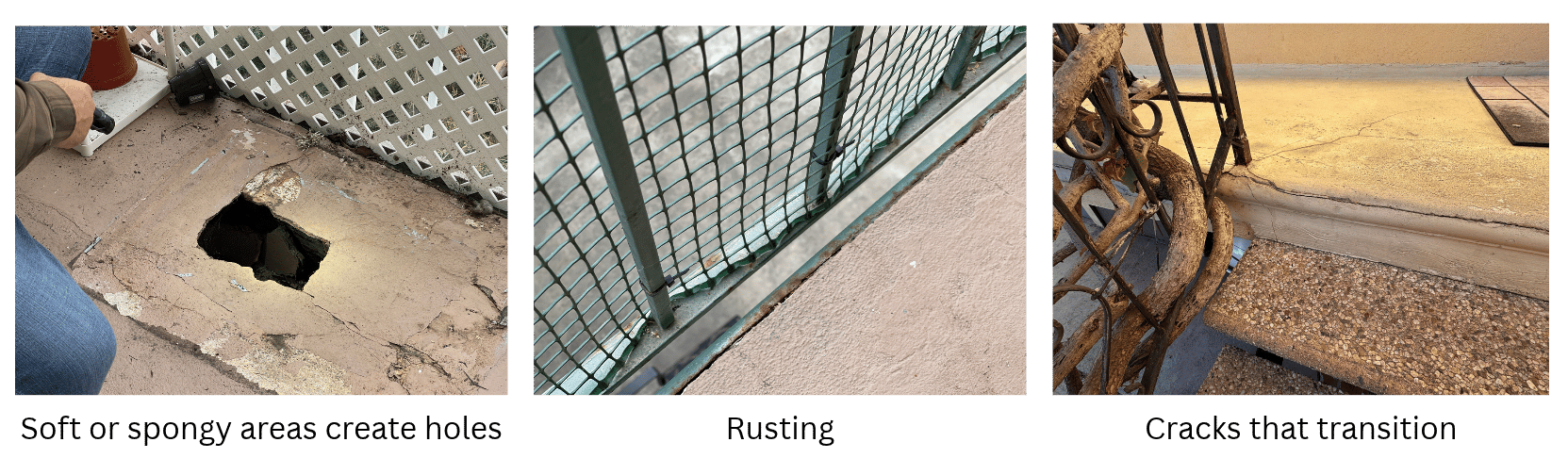
Soft or spongy areas in the walking surface, especially near the door threshold or the outer edge.
Water that stands on the surface after rain or irrigation while the rest of the balcony dries.
Rust stains or rust bleed near railing posts, fasteners or connection points.
Cracks at transitions, rail bases or edges that line up with staining or softness.
A railing that moves when pushed.
Sagging, a new slope, bounce or movement when walked on.
Bubbling stucco or water stains on the underside of the balcony or the wall below it.
On concrete balconies, spalling or exposed rebar.
| SIGN YOU CAN SEE | WHAT IT CAN INDICATE | ||
|---|---|---|---|
 |
Soft or spongy spot near the door or edge | → | Water entry at the flashing, waterproofing or drainage, and possible framing decay. |
 |
Water that stands after rain or irrigation | → | A slope, coating or drain problem, and prolonged moisture exposure. |
 |
Rust bleed at railing posts or fasteners | → | Water reaching metal connectors or rebar, and corrosion. |
 |
Cracks that line up with staining or softness | → | Movement or repeated water entry below the surface. |
 |
A railing that moves when pushed | → | An anchorage or framing problem at the connection. |
 |
Sagging, a new slope, bounce or movement | → | Framing or a connection that has lost strength. |
 |
Bubbling stucco or water stains underneath | → | Water moving through the balcony toward the underside or the wall below. |
 |
Spalling or exposed rebar on concrete | → | Rebar corrosion that is underway. |
Only an inspection confirms the condition underneath.
Cracks, worn coatings and small areas of surface spalling can be cosmetic. Only an inspection confirms whether the framing, the connections and the waterproofing underneath are sound.
Patching a balcony makes sense when the damage is limited to the surface and the structure underneath is sound. In those cases a targeted fix can stop the problem and extend the life of the balcony without the cost of a rebuild. Patching is usually appropriate when:
The damage is surface wear, such as a worn coating, minor cracking or small areas of spalling, on a slab or frame that is still solid.
There is a single source of moisture that can be traced and stopped, such as a failed sealant joint or a drainage problem.
The load-bearing members, including the joists, ledgers and any rebar, remain intact and show no decay or corrosion.
An inspection confirms the balcony is safe and recommends maintenance instead of structural work.
The surrounding waterproofing still has service life left, so the patch can tie into a system that is performing.
When those conditions are met, a repair that addresses the root cause is the practical choice. A repair that includes correcting the slope, the flashing and the drainage holds longer than one that seals the visible spot alone.
Replacement becomes the safer choice when the damage reaches the structure or keeps returning after repairs. At that point a localized fix leaves the underlying problem in place, and the balcony keeps deteriorating. Replacement is usually the better option when:
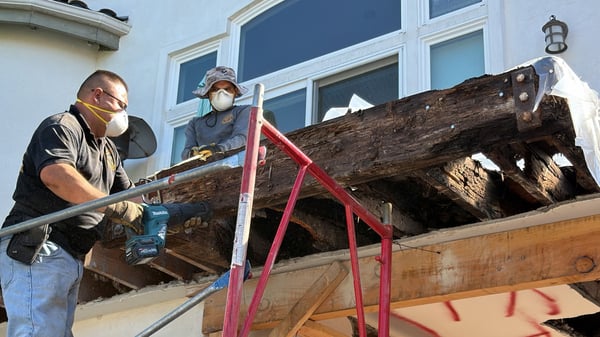
The framing shows widespread wood rot, or the joists, ledgers or outriggers have lost strength.
The rebar or metal connectors are heavily corroded, which weakens the balcony and continues to spread as the corrosion advances.
Repairs have been done before and the leaking, cracking or movement keeps coming back.
The existing design or materials no longer meet current building code.
Several components, such as the framing, the waterproofing and the railing, are reaching the end of their service life at the same time.
The balcony has reached the point where rebuilding from the structure out costs less over time than another round of repairs.
Here is how inspection findings point to a path:
There is no single percentage of damage that decides this. The inspection findings decide it.
Replacing the balcony removes the hidden damage and resets the lifespan of the framing and the waterproofing together. There is no single percentage of damage at which every balcony should be replaced, so the decision rests on the inspection findings for that balcony.
A cheap balcony patch often comes back as a bigger repair because the condition that caused the first failure keeps working after the surface is sealed. The cost looks lower at the start, and the larger repair arrives later. The process is straightforward to follow:
Water reaches the framing through a crack, a failed joint or a worn coating. The framing stays wet, the wood begins to rot, and the rot spreads to the members connected to it.
On concrete balconies, water reaches the steel rebar and it corrodes. The corroding steel expands, pushes off the surrounding concrete and exposes more steel, so the damage keeps advancing under any patch placed on top of it.
A coating applied over a surface that is still wet or still leaking traps moisture against the structure, and the patch fails again.
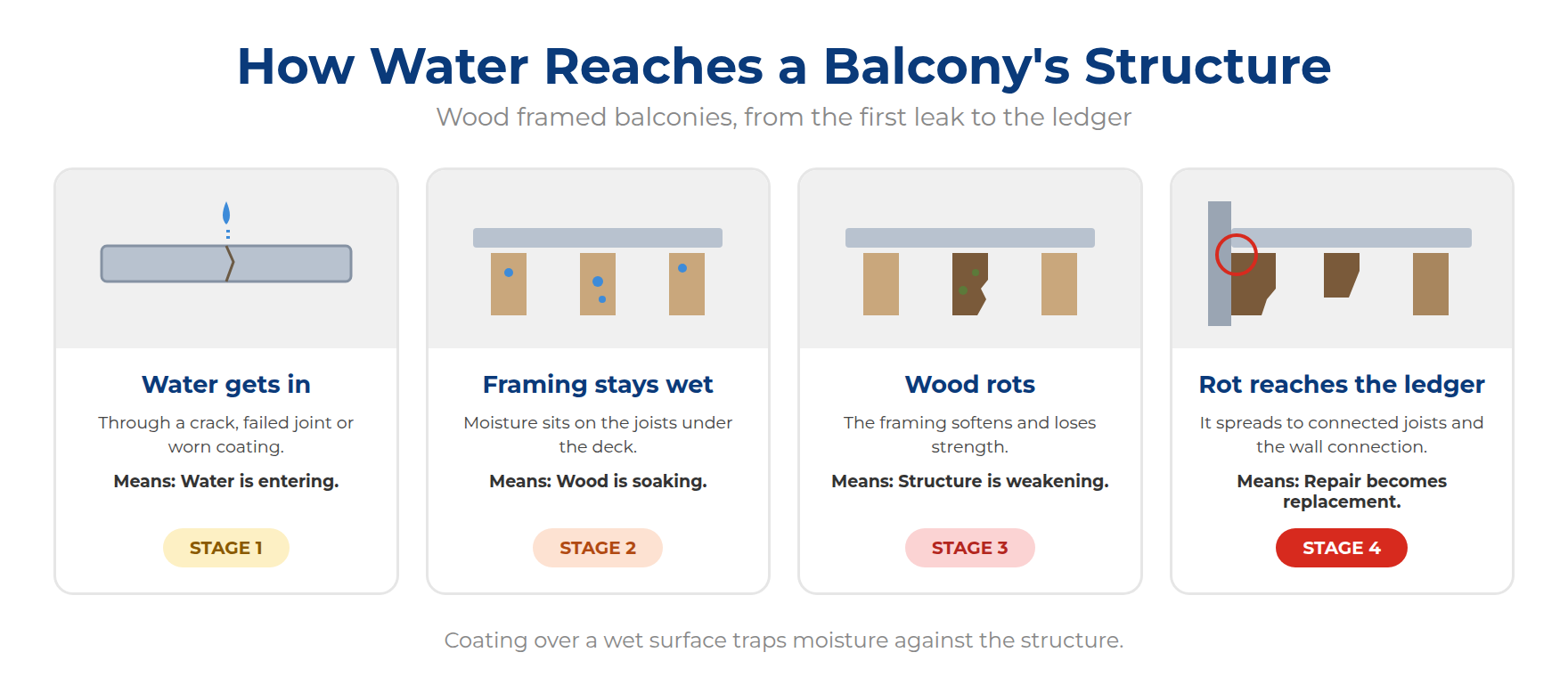
Each time the balcony is opened for another repair, the access, the setup and the waterproofing work are repeated, so the money spent on a series of patches adds up while the original problem remains. This is the same chain of events behind the most serious balcony failures, which is why addressing the water source matters as much as the visible fix.
The cost of a balcony repair or replacement depends on the scope of the work and the conditions on site, which is why a firm number comes from an assessment instead of a price list. The factors that move the cost the most are:
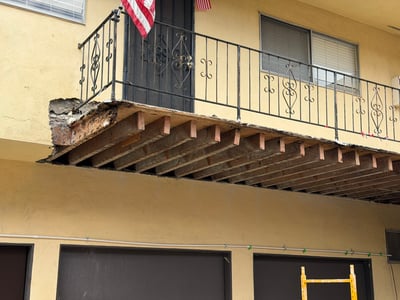
Extent and location of the damage, from a single surface area to framing that runs the length of the balcony.
Concealed conditions that are only found once the balcony is opened, which can shift a job from cosmetic to structural.
Access and height, since upper floors need scaffolding, swing stages or lifts that ground-floor work does not.
Material, because concrete repair, wood framing replacement and connection hardware each carry their own labor and cure times.
Waterproofing scope, which has to be restored as part of the work. In some cases the structural repair is small and the waterproofing system needs full replacement, because a new patch may not bond reliably to an aged membrane.
Railings, which may need to be removed and reset, repaired or replaced to meet current code.
Engineering and permits, which vary by city and by the size of the structural work. Under SB 721, all necessary permits must be obtained from the local jurisdiction for repair or replacement work.
Asbestos testing on buildings built before 1981, which is required before any demolition can begin.
Resident coordination and restricted access on occupied and multi-unit buildings, which affects scheduling and setup.
Here is what moves the cost of balcony work:
A firm number comes from an on site assessment.
Comprehensive scoping before the work starts is what keeps these factors from turning into change orders after the project is underway. A bid built on visible damage alone tends to grow once the balcony is opened, and the owner absorbs the difference.
Whether it is cheaper to repair or replace a balcony depends on how long you hold the property and whether the repair addresses the root cause. A single, well-scoped repair on a sound structure is the lower-cost path and the right one. The comparison changes when the structure is already compromised, because then the choice is between one replacement and a series of repairs that each address the symptom while the underlying problem continues.
A replacement carries the higher upfront cost, and it resets the service life of the framing and the waterproofing, so the clock starts over.
A series of patches carries a lower cost each time, and it repeats the access, setup, permit and waterproofing work with every visit while leaving the root problem in place.
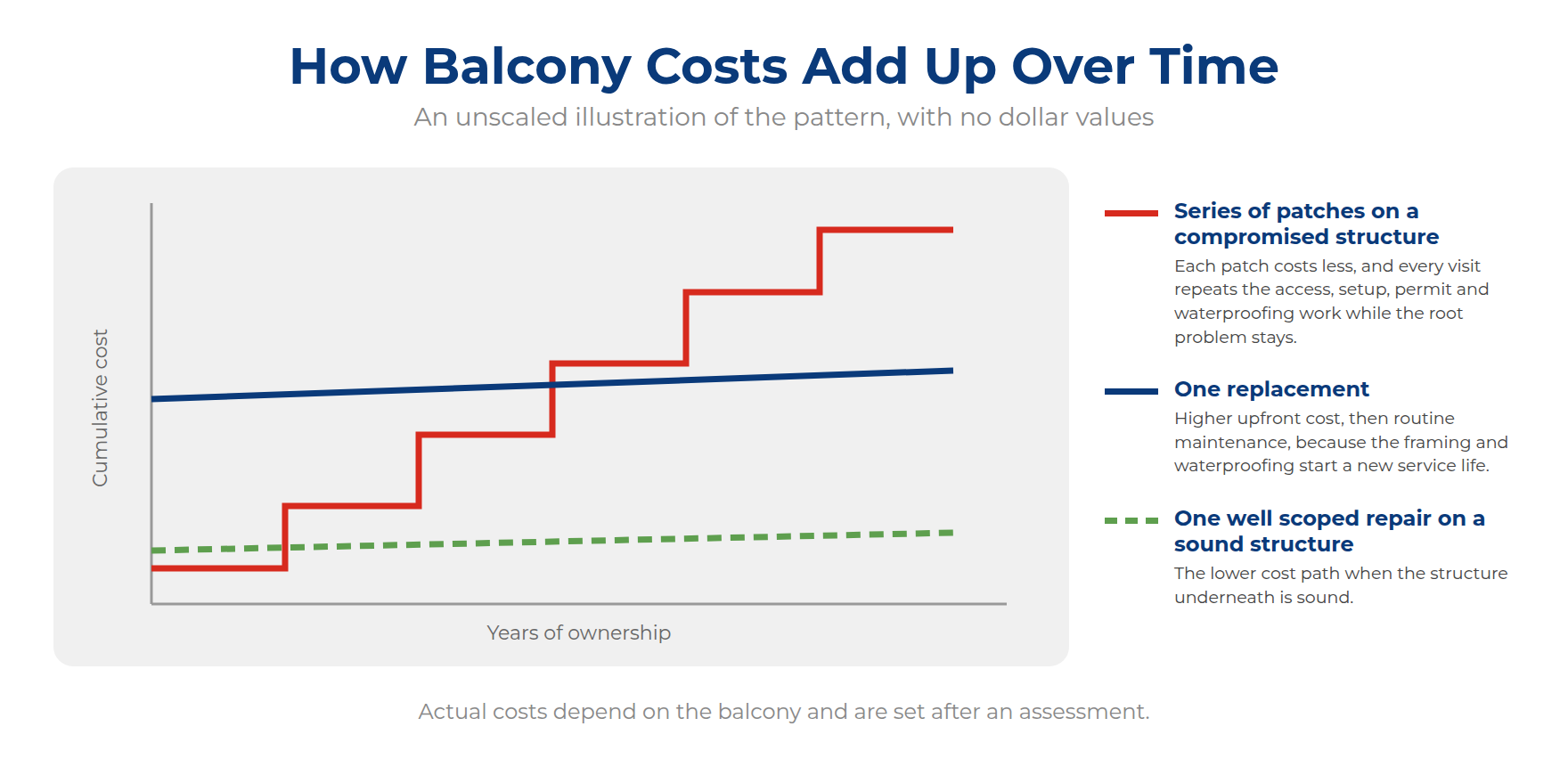
Repeated work also has costs that do not appear on a contractor invoice. Each round can mean restricted balcony access for residents, another round of notices and scheduling, and on larger buildings a mismatch in railings or finishes between repaired and original sections. Looking at the total cost over the years you own the balcony is what makes the right choice clear.
California has two balcony inspection laws, and whether they apply to you depends on the kind of building you own. If you own a single-family home, SB 721 and SB 326 generally do not apply to your balcony, although the structural and cost questions in this article still do. If you own or manage a multi-unit rental or a condominium, the laws apply and set a schedule you have to meet. Both laws cover exterior elevated elements on buildings with three or more multifamily dwelling units.
SB 721 (Health and Safety Code Section 17973) covers apartment buildings with three or more units. The initial inspection deadline was extended to January 1, 2026 by Assembly Bill 2579 and has now passed. Re-inspections are required by January 1 every six years after that. The inspection may be performed by a licensed architect, a licensed civil or structural engineer, a contractor holding an A, B or C-5 license with at least five years of experience constructing multistory wood frame buildings, or a certified building inspector or building official. At least 15 percent of each type of exterior elevated element must be inspected.
SB 326 (Civil Code Section 5551) covers condominium associations. The first inspection was due by January 1, 2025, and inspections repeat at least once every nine years. The inspection must be performed by a licensed structural or civil engineer or architect, on a random and statistically significant sample of the exterior elevated elements the association is responsible for maintaining. The statute defines that sample as enough units to provide 95 percent confidence with a margin of error of no more than plus or minus 5 percent.
Here is how the two laws compare:
Sources: California Health and Safety Code 17973; Civil Code 5551.
AB 2579 extended the SB 721 deadline for apartment buildings only. It did not change the SB 326 deadline for condominiums.
When an inspection finds a problem, the law sets the next steps.
Under both laws, if the inspector finds that an element poses an immediate threat to occupant safety, the report goes to the local enforcement agency within 15 days, and the owner or association must prevent access to that element right away.
Under SB 721, work that is not an immediate threat requires a permit application within 120 days of receiving the report. Once the permit is approved, the owner has 120 days to complete the repairs unless the local agency grants an extension. All repair and replacement work must be performed by a qualified and licensed contractor.
Under SB 721, if repairs are not completed within 180 days, the inspector notifies the local agency. If the repairs are still not complete 30 days after that notice, the owner is assessed a daily civil penalty set by the local authority until the repairs are done, and the local jurisdiction may record a building safety lien.
Under SB 721, inspection reports must be kept for at least two inspection cycles and disclosed to the buyer when the building is sold. Under SB 326, associations must keep the reports for two inspection cycles.
Here is the SB 721 timeline after an inspection report:
Penalty amounts are set by the local authority. All repair and replacement work must be performed by a qualified and licensed contractor. Source: California Health and Safety Code 17973.
A failed or deficient inspection moves the repair-or-replace decision from a choice to a schedule. These laws exist because of the 2015 Berkeley balcony collapse, which killed six people and injured seven. Investigators found the cause was dry rot in the wood beams that supported the balcony, the result of water reaching the structure and going unaddressed. That is the same chain this article describes, which is why inspection and water management matter whether or not a law requires them.
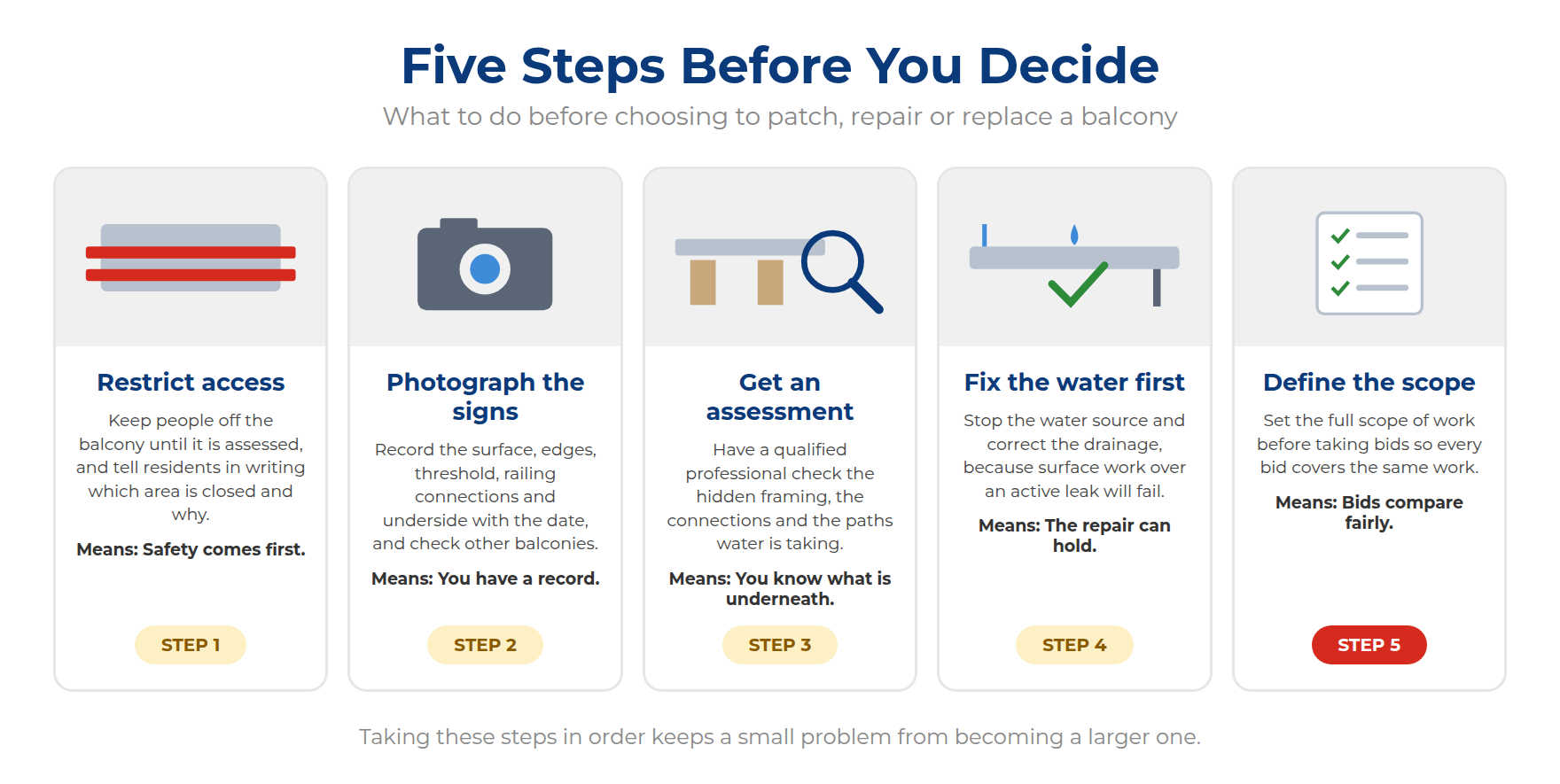
Before you decide between repair and replacement, a few steps protect both safety and budget. Taking them in order keeps a small problem from becoming a larger one.
Restrict access to the balcony if you see cracks, sagging, bubbling stucco, water stains or any movement, and keep people off it until it has been assessed. On an occupied building, tell residents in writing which area is closed and why.
Photograph the symptoms, including the walking surface, the edges, the door threshold, the railing connections and the underside, and note the date. Check whether other balconies on the property show the same signs.
Get a qualified assessment of the hidden framing, the connections and the paths water is taking, instead of judging the balcony by its surface.
Fix the water source and the drainage first, because any surface work placed over an active leak will fail.
Define the full scope of the work before you take bids, so the numbers you compare cover the same work and you are not weighing a thorough bid against a thin one.
Bids for the same balcony can differ widely because they describe different scopes of work. Comparing them line by line shows which bid covers the root cause. Ask each contractor to show the following separately:
The structural work, including which framing members, connectors or rebar will be repaired or replaced.
The waterproofing system, including flashing at the wall, slope correction and drains.
Access equipment, such as scaffolding or lifts.
Engineering, permits and inspections.
Asbestos testing on buildings built before 1981.
How the bid handles concealed conditions found once the balcony is opened.
A bid that prices only the visible surface will look lower, and it is the bid most likely to grow through change orders.
Bay Cities Construction is a licensed general contractor based in Torrance and Newport Beach, serving Los Angeles, the South Bay and Orange County, and balcony repair and waterproofing is the core of our work. The approach is built around finding the real condition of the balcony before a scope is set, whether the job is one balcony on a single home or balconies across a multi-unit portfolio.
Bay Cities handles permitting and works closely with an engineer on each project. Clients are welcome to bring their own engineer, and most choose to work with the Bay Cities engineer.
Comprehensive scoping up front prevents the change orders that come from bidding on visible damage alone.
The Limited Demo Discovery is a diagnostic step that opens the balcony to expose the actual structural condition, so the scope and the plan are based on what is underneath the surface. The on-site visit to scope the discovery is free, and the exact price is confirmed after that visit.
For buildings built before 1981, Bay Cities coordinates the required asbestos testing before any demolition begins. If asbestos is found, Bay Cities connects the client with a certified abatement specialist.
If you are weighing a repair against a replacement, the clearest next step is to have the balcony assessed and to get an estimate based on its real condition.
Name: You
Question: Repair or replace?
WHAT ARE YOU SEEING? (CHECK ALL THAT APPLY)
NEXT: REQUEST → UPLOAD PHOTOS → ZOOM WITH ALEX → SITE VISIT
1 min read
In Southern California, balcony waterproofing fails faster than almost anywhere else in the country. The combination of intense UV exposure, coastal...
1 min read
{% video_player "embed_player" overrideable=False, type='hsvideo2', hide_playlist=True, viral_sharing=False, embed_button=False, autoplay=True,...
1 min read
🚨 The SB 721 Deadline Has Passed The January 1, 2026 compliance deadline for SB 721 inspections has come and gone. If your multifamily...